Executive Summary
Shared risk in business deals decides who stays honest and who walks away clean. A 90-day pilot that stalled showed me the rule plainly. When one side carries all the downside, momentum dies. Split the risk or end the talks early.
The Inbound That Kept Hitting a Wall
An agency overseas had a strange problem. Buyers kept finding them anyway.
Those buyers wanted developers who worked inside one niche fintech platform. Every call ended the same way. “Are you an official partner?” The answer was no. The agency had burned 18 months chasing that badge with nothing to show for it.
So they hired me to open the US market for that single platform: to start conversations, sign deals and earn the partner status that kept sliding out of reach.
On paper it was clean. In practice the first 60 days looked promising: warm inbound and a narrow niche that matched their team. Early signals rarely tell you if a deal will survive its own terms.
What 90 Days With Real Buyers Revealed
We ran roughly 40 conversations. Maybe five turned serious. Two asked for proposals with prices attached. None of them signed.
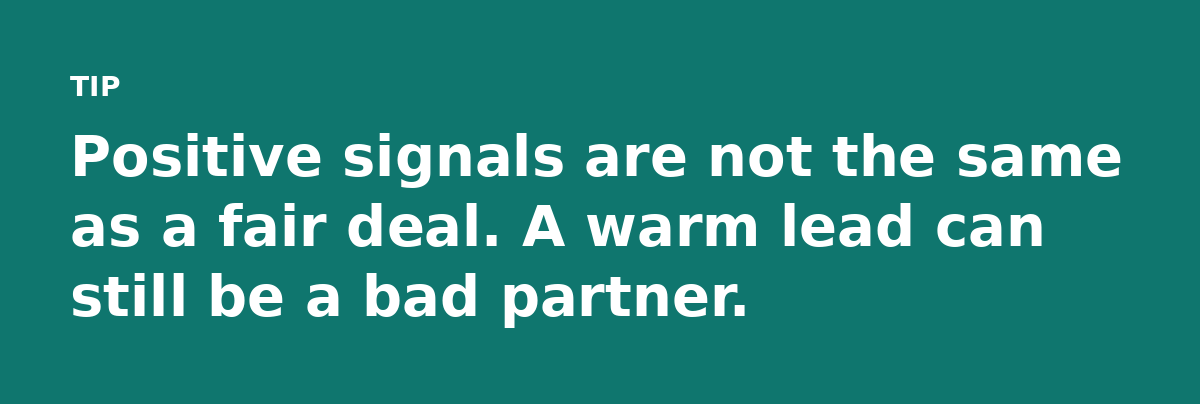
The reason was always the same line. “We need an official partner.” Buyers were protecting themselves; an unofficial vendor carries risk they do not want to own.
So the whole deal rested on one thing. Someone had to fund the path to partner status: marketing, application work, the first few hires and the early campaigns. That cost money before a single dollar came back.
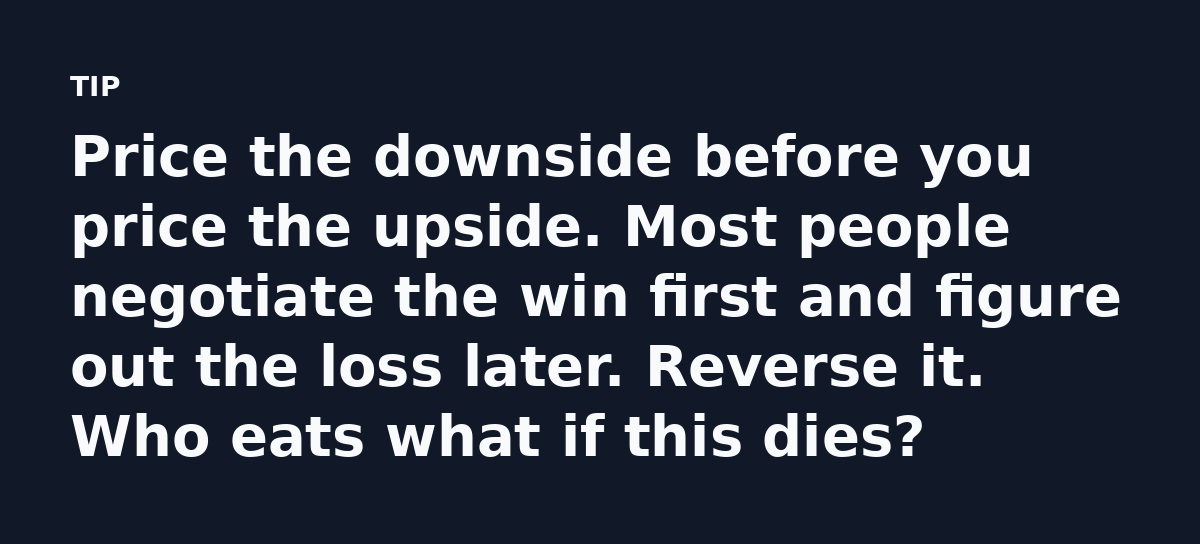
That is when the real negotiation started. It was about who carried the risk if it failed.
The Break Point at Day 90
The proposal on the table asked me to cover the early costs. If the niche worked out, I would get paid back later. If it failed, I would take the loss alone.
That arrangement put the entire downside on one side of the table. Their exposure was time. Mine was cash and reputation.
I said no, they pushed back and we could not agree on how to move forward. The relationship ended.
Why One-Sided Risk Always Slows Down
When only one person can lose, that person moves carefully. Every dollar gets checked twice and every decision waits for a second opinion. The other side has no reason to hurry.
That gap is the real killer. The funding side stalls and the protected side keeps its options open. The deal quietly freezes.
I have seen this in sales partnerships and joint ventures. The party with no skin in the game treats the project as optional.
Shared Risk in Business Deals: How to Split It With Real Numbers
A simple split that ties cost to upside does the job. Here is the model I use now when a pilot needs upfront money.
| Line item | Who funds it | Who wins first if it works |
|---|---|---|
| Pilot campaign spend | Split 50/50 | Covers both, no profit split yet |
| Partner or license fees | Client side | Client, since they keep the asset |
| First two hires | Whoever owns the client relationship | That same side |
| Legal and admin | Shared by effort | Both, as a fixed cost |
The principle sits in the last column. Whoever keeps the asset funds the asset. If the client owns the partner relationship, the client pays to build it. If I own the leads, I cover the cost to find them.
The Scorecard I Run Before I Sign Anything
Four questions, asked out loud, no softening.
- If this fails, who pays and how much?
- If this works, who earns more per hour of effort?
- Can either side leave inside 30 days without a penalty?
- What does each side put in during the first two weeks?
Question four is the one that ends bad deals fast. People promise money and effort later. I want proof in the first 14 days: a small deposit or a signed scope is enough.
The Day I Walked
Saying no felt wrong at the time, with good inbound and a team that could actually do the work.
But the terms handed me the whole floor. If the niche collapsed I had no cushion. Walking cost me one opportunity. Staying would have cost months and real cash.
That trade was easy once I wrote it down. One loss versus many.
What to Do Before Your Next Deal
Ask the other side to fund the first step: a hundred dollars or one warm intro they have to make themselves. The size does not matter. The willingness does.
If they push the whole risk back on you, you just learned how they see the partnership. Believe it the first time.
Write the downside split on one page. If both sides cannot sign that page, do not start the pilot. Shared risk is what keeps the work moving when the results are slow.
One Thing to Remember
Check who carries the loss before you check who gets the win. That single question saved me more money than any sales tactic I know.
Watch the 30 second summary
Video transcript: If failure only hurts one person, that person slows down. They check every dollar twice while the other side stays free to wait. When one side carries no downside, the project becomes optional. They keep options open and the deal quietly freezes. Shared risk keeps both sides honest. If both can lose, both have reason to move and to finish what they started. If you cannot agree on who carries the downside, walk away at day one. A stalled deal costs more than a clean no.