Executive Summary
Most teams grade their automation on one number. That number is flow count. What matters is how many distinct customer triggers you answer and whether each one earns its keep. This list gives you the math to size the program and the rules to audit the email automation flows you already run.
1. Count Triggers, Not Campaign Variations
A welcome series with five emails is one flow. A wholesale welcome series and a retail welcome series are two. The number that counts is how many distinct triggers you respond to.
Open your automation tab and write every trigger down: first order, second order, cart abandon, browse abandon and winback. Variations inside a series inflate the number and hide the gaps.
2. Size the Program to Purchase Frequency
Here is the simple version of the math. Take your average orders per customer each year. Call it F. A customer who buys twice a year leaves roughly six months of silence between orders. Every gap is a candidate trigger.
If F is two, you have at least two purchase-driven moments sitting unused. If F is six, the same logic hands you six. The formula is blunt: candidate flows equals orders per year, doubled for the intent moments around each purchase.
This is why a 20-flow account makes sense. It usually means someone mapped 20 moments where behavior changed and built a response for each one.
3. Map a Trigger to Every Order Threshold
Order count is one of the cheapest triggers to build. It needs no external data. Just the customer’s history.
A small handmade biscuit shop ran on this. Their buyer averaged two orders per year. So the team built a flow at the second order that granted VIP status and a flow at the third order that added free shipping. The nudge hit the exact moment the habit was forming.
Second order says hello again and third order says stay, both without a human touching anything.
Watch your margins
Free shipping on order three is a cost. Before you ship it, check your average order value. If the third-order margin cannot absorb the perk, move the reward to order four or switch to a points offer. The trigger stays, the reward shifts.
4. Time the Nudge to the Customer Clock
A trigger without a delay is half built. The delay is where most programs leak money.
Suppose a customer buys every 180 days. A winback at day 90 annoys them and a winback at day 200 catches them one cycle late. Split the difference. Trigger the reminder at roughly 70 percent of the expected gap.
Track it. When the average gap moves, the delay moves with it.
5. Add Suppression Before You Add Another Flow
More flows create collisions. A customer can land in a winback and a browse abandon at the same time. Build your suppression rules first. Priority order works well: transactional beats lifecycle and lifecycle beats promotional. Then a live purchase should pull the customer out of every incomplete flow instantly.
6. Measure Incremental Lift, Not Opens
Opens tell you the subject line worked. They say nothing about whether the flow made money. Use a holdout group: withhold 10 percent of eligible customers from each flow and compare revenue side by side.
Incremental revenue equals revenue from the exposed group minus revenue from the holdout, adjusted for group size. If that number is near zero the flow is decoration.
Kill it. Free the send volume for something that moves.
7. Set a Ceiling on How Much You Maintain
Every flow needs an owner and a review. Pick a ceiling you can actually tend. Ten well-monitored email automation flows beat 30 abandoned ones.
Once a quarter, open each flow and read the copy. Prices change. Links rot. A stale flow quietly sends wrong information to your best buyers.
8. Start With the Two That Pay First
If you are building from zero, start with two.
Build the welcome flow. Then build a second-order flow. Those two touch every new buyer at the moment they are most engaged. They need no complex segmentation and no forecasting.
Add one trigger at a time.
What to Do This Week
Pull your automation list. Recount it by trigger and delete the duplicates. Find your orders-per-year average. Then pick the single order threshold most of your customers cross and build one flow for it.
Watch the 30 second summary
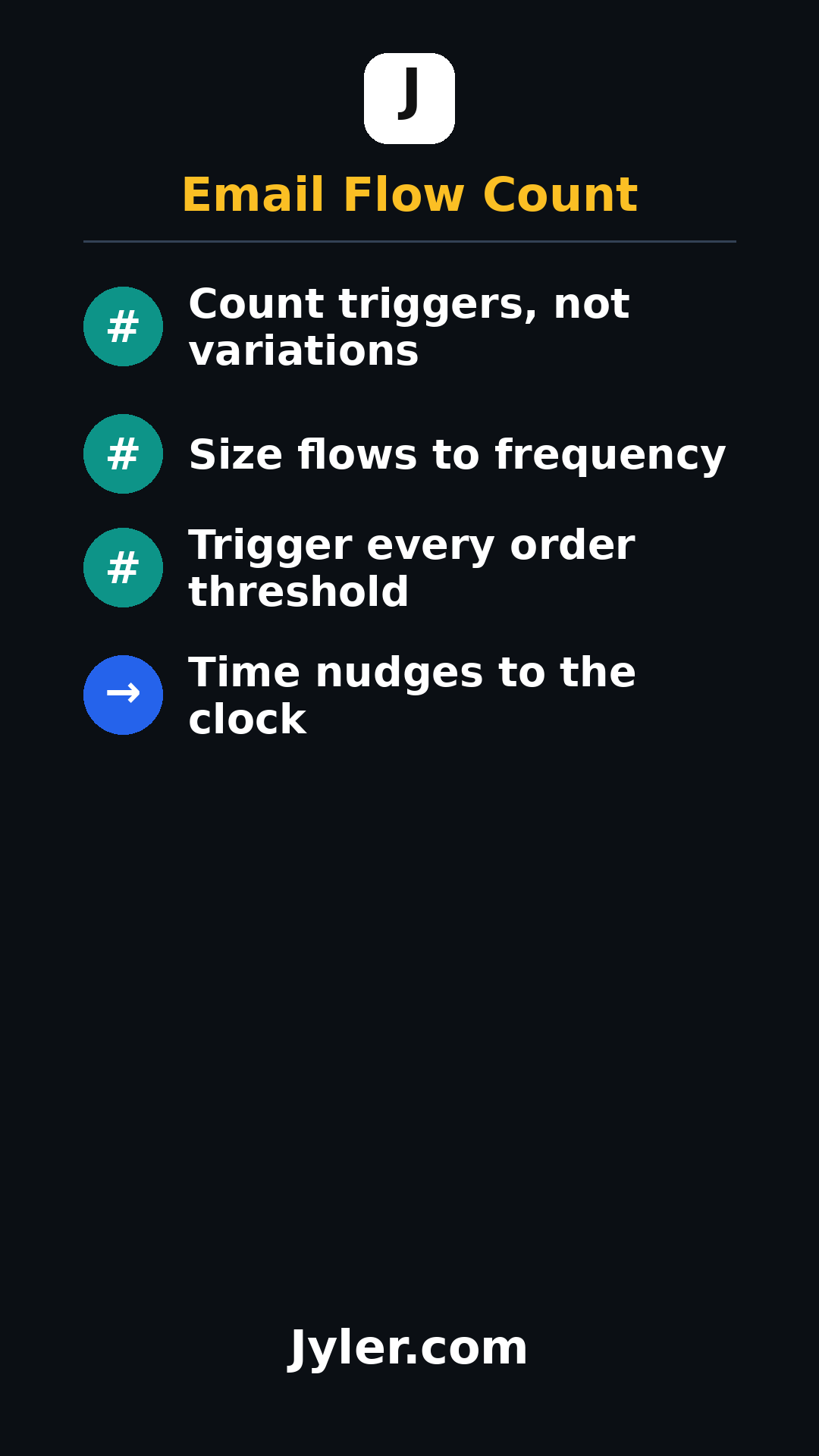
Video transcript: Count triggers not variations. Size flows to order frequency. Trigger on every order threshold. Time nudges to the customer clock.