
Key Takeaway
A blog post that flatlines in week four has a measurable cause. That cause is often the search intent or the ranking. Run a 30-day content decay audit before you touch the draft. An hour of checks shows you which lever to pull.
What is a content decay audit?
It is a fixed set of checks you run on one post to find why traffic stopped growing. You compare what you expected with what the page actually did in its first 30 days. The audit ends with a decision. Fix one specific part or leave the post alone.
Why do posts plateau after the first month?
Search engines test new content on a small set of queries. In the first two weeks a fresh page can rank higher than it deserves because few competitors are showing yet. Then the test window closes.
Positions settle. If your page lands at number 9 instead of number 3, clicks can drop by 80 percent even when impressions hold steady. That drop can look like decay, but it is really a ranking result you never noticed.
Which numbers do I pull first?
- Impressions and clicks for the post, split by week across the last 90 days.
- Average position for each query the page ranks for.
- Click-through rate sitting next to the position for that query.
- Bounce and scroll depth if your analytics tracks them.
What does a healthy curve look like?
Almost nobody gets a smooth climb. A page that ends month one with 60 percent of its week-one impressions is normal. A page that keeps 15 percent has a problem. Put the two week numbers side by side. The gap is your first clue.
Is falling impressions the same as decay?
No. Decay means the page lost ground it once had. A new post that never ranked never held that ground. That needs a different fix: rewrite the targeting. For real decay, check what changed on the page or in the results.
Where does the traffic actually leak?
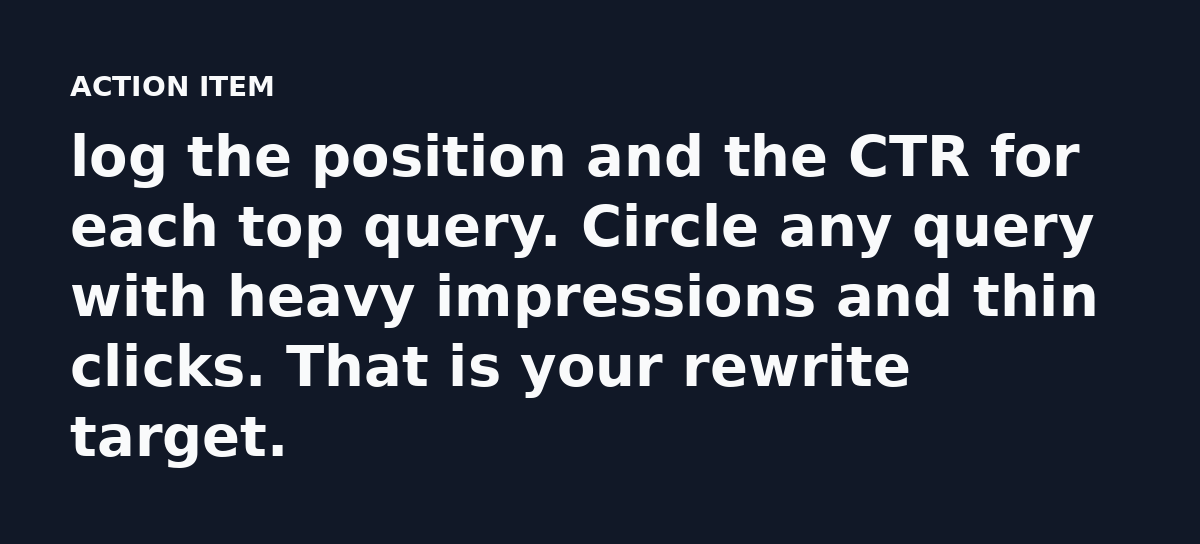
Pull the query report, sort it by impressions and look at position. A query where you sit at number 6 with 4,000 impressions is a bigger prize than one where you sit at number 2 with 90 impressions. Fix the first one.
Then check CTR. A page in position 3 should earn roughly a quarter of the clicks for that query. A page in position 9 often earns under 2 percent. If your page earns 4 percent in position 3, the title is turning people away.
What if impressions are fine but clicks never come?
This is a snippet problem nine times out of ten. The page shows up, people read your title in the results and skip it. Open the search results for your main query. Look at how your title reads next to the four results above it. If yours is vague or stuffed with keywords, fix it.
What if the page ranks for the wrong query?
Intent mismatch is common. You wrote a how-to and the search engine ranks it for a definition. The searcher wants a one-line answer and leaves your 2,000-word guide in ten seconds. Compare the top query against your opening paragraph.
If they do not match, retarget. Either reshape the content to serve that query or change the title to chase the query you actually wanted.
Could another page on my site be stealing the traffic?
Yes. Keyword cannibalization is easy to miss. Search your own site for the main query. When two URLs compete for the same phrase, the search engine picks one and the other withers. Open the query report and look for the same query under two addresses. Merge them into one strong page. Two weak pages lose to one focused page every time.
When should I rewrite versus leave it alone?
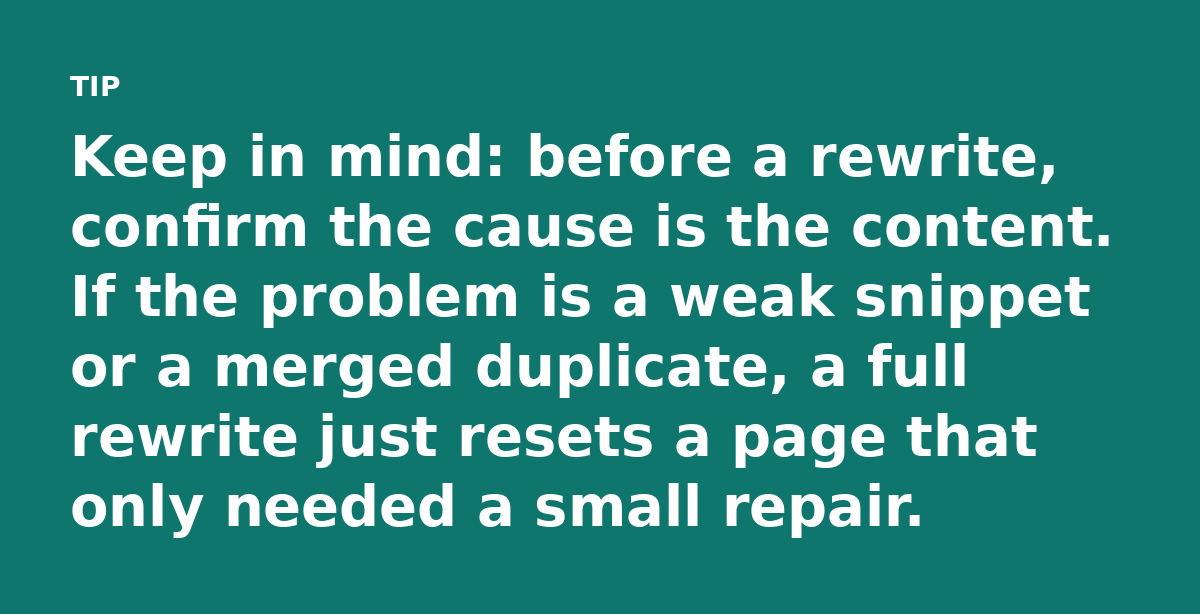
Rewrite when the audit points to one clear defect. Leave it alone when the page is still rising and the numbers just look slow.
Set a threshold before you start. Example: rewrite only if the page holds high impressions and its CTR falls below the average for its position. If it fails that test, do the smaller fix first.
What if nothing on my page changed?
Then look outside. A competitor published a stronger page. A featured snippet may now answer the query above your link. Check the impression trend across 12 months. A dip that shows up every year is just the calendar.
How long should this take?
Sixty to ninety minutes for one post. Most of that is reading the query report. If it runs longer, you are overthinking a decision the data already made.
The one move for today
Pick the post with the most impressions and the weakest click-through rate. Run this audit on it now. Fix the snippet first. Wait 14 days and compare the numbers. That single loop beats rewriting ten posts on a hunch.
Read the full guide: Blog Post Update Flat After a Month? 6 Checks Before You Rewrite Again