Key Takeaway
B2G lead generation works when you treat public records as your lead list and the budget calendar as your timing signal. Most vendors wait for the RFP. By then the requirements are already written around someone else. This guide shows you how to get scored and contacted before that happens.
Every step below runs on free or cheap data.
Why Government Leads Feel Harder Than They Are
Public buyers publish budgets, awards, org charts and meeting minutes. According to public spending data, the federal government alone spends more than $700 billion a year on contracts and roughly a quarter of that is targeted at small business set-asides.
The problem is volume. A single state portal can list thousands of open solicitations. Nobody can read them all. So the work is filtering.
Here is the core idea: a strong B2G lead is a named agency contact with a budget line and a contract that expires on a known date.
Where Most Teams Lose the Deal
They build a list from a scraped email dump and send a generic capability statement. Nine months later they see the award notice and assume the process was rigged.
It rarely is. The winning vendor talked to the program manager long before the solicitation existed.
Step 1: Find Out Who Signs and Who Suggests
Two roles matter in every agency: the contracting officer and the program manager. The contracting officer controls the process. The program manager controls the problem.
You need both in your CRM. Different fields. Different outreach. The program manager cares about service delivery. The contracting officer cares about compliance and documentation.
Search the agency website for the procurement office page. Most list assigned buyers by commodity. Map three names per target agency and you have a real starting point.
What a Complete Contact Record Looks Like
- Name and direct email from the agency staff directory
- Program area and the outcome that role is measured on
Skip the generic info@ address. It lands in a shared inbox and dies there.
Step 2: Build the List From Public Records, Not Guesswork
USAspending.gov lists federal contract awards with the buyer and incumbent. State portals publish the same for their own agencies. City council agendas often include purchase approvals before the contract is signed.
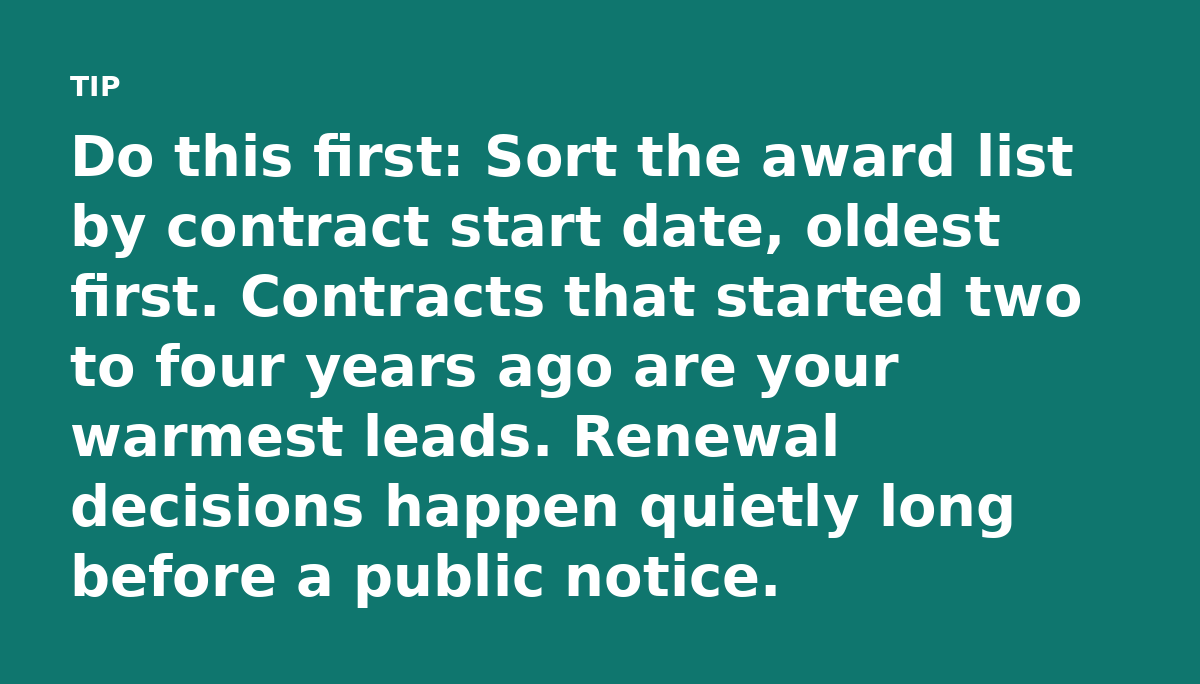
Pull every award in your category from the last two fiscal years. Note the dollar value and the start date. That single spreadsheet tells you where the money already flows.
Step 3: Score Leads Against the Budget Calendar
The federal fiscal year closes September 30 and most states close June 30. Agencies spend in bursts near those dates and freeze new spending right after.
Build a simple score out of four inputs:
- Budget window fit, meaning how close you are to the spending push
- Contract expiry within the next twelve months
- A published problem you can actually solve
- Access to a named contact in the right office
Give each input a score from one to five. A lead with a low budget fit and no expiring contract is a research task. Park it.
The Filter That Saves the Most Time
Remove any agency that buys your category through a cooperative contract. According to public procurement rules, cooperative contracts such as Sourcewell and NASPO ValuePoint let agencies buy without a new solicitation. You either get onto that vehicle or you sell to the resellers who hold it.
Chasing a direct deal there wastes months. Know the buying route before you make contact.
Step 4: Show Up Before the Solicitation
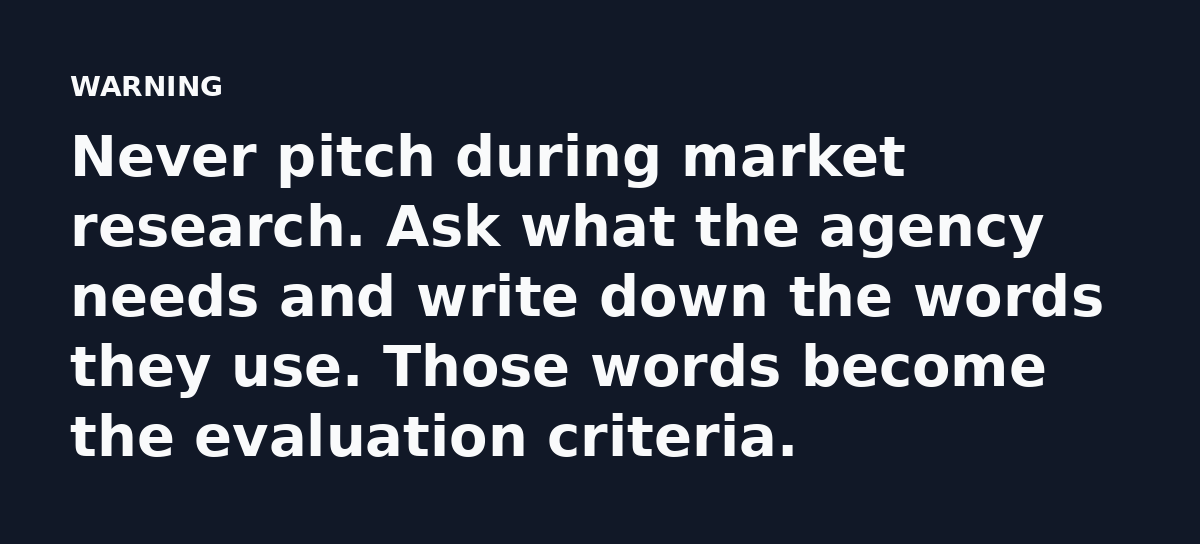
Agencies run market research before they write requirements. They issue requests for information and hold industry days. Those events are open invitations to shape the spec.
Respond to every RFI in your category. Keep it short. Answer the exact question asked and add one page on how your approach reduces risk.
Send one useful item a quarter to each named contact. A short note about a funding program or a compliance change works better than a newsletter. Each touch earns the right to a real conversation.
Step 5: Read the Award History, Not the Email Reply
Email opens tell you very little in this market because procurement cycles are slow and quiet. Track record signals instead.
Watch for a new RFI or a contract modification on an existing award. Those events move a lead forward. Silence does not mean no.
Log every touch with a date. Public buyers get frequent vendor contact and a documented history helps you stay useful without becoming noise.
Step 6: Hand Sales a Brief They Can Use
The worst handoff is a name and an email address. Build a one-page brief for each qualified lead. Include the agency mission, the expiring contract, the named contacts, the buying vehicle and the exact words the agency uses for the problem.
Add the last three awards in that category with values. Sales can open with a specific number.
What to Measure
Track four numbers: named contacts added, RFIs answered, briefs delivered and conversations held. Award value comes later. Those four show whether your B2G lead generation engine is actually running.
Your Move This Week
Pick one agency and pull its last two years of awards in your category. Find two names in the procurement office and one program manager.
Then check the fiscal calendar and note the next spending window. That is your first qualified B2G lead and the exercise takes about ninety minutes.
Need this run for you? See the outreach service.