Key Takeaway
B2G lead generation breaks when you count names instead of buying paths. B2G means business to government. A public sector lead is worth working only when you can tie it to a budget line, a procurement route, a named champion and a timeline. Fix that filter and your pipeline stops filling with contacts who never had a way to buy.
Most teams learn this after a wasted quarter. According to public spending data, the federal government alone awards more than $700 billion in contracts each year, while state and local agencies add hundreds of billions more. The path to it is not the same as a corporate sale.
Why public buyers move on a different clock
A government sale often runs 12 to 18 months. A single purchase can need budget approval, a procurement review, an IT security sign-off and a legal check. Your contact may love the product and still have no authority to sign.
That gap explains most wasted effort. Sales teams send more email while marketers add more names. Nobody maps the route the buyer must walk.
Mistake 1: Counting contacts instead of buying paths
A list of 5,000 agency emails feels like progress. It is inventory. Demand is the thing that closes.
Define a qualified B2G lead with four checks. Is there an approved budget or an active appropriation? Is there a contract vehicle the agency can use? Do you know the person who owns the problem? Is there a realistic award window?
No budget means no deal this fiscal year. No vehicle means a long procurement detour.
Use a simple score
Give each lead one point per check. Four points is a working lead. Two points or fewer belongs in nurture, so keep it out of the forecast call.
Mistake 2: Waiting for the RFP to land
By the time a request for proposal is public, the requirements often carry the shape of an incumbent. You are late. The winner helped write the draft.
Watch the quiet stages instead. Agencies publish requests for information, sources sought notices, market research questions and draft statements of work months before a formal bid. Each one is a free opening to educate the buyer.
Answer one RFI this month. Keep it short and explain how similar agencies solved the problem and what it cost. That reply can put you on the shortlist before a solicitation exists.
Mistake 3: Running B2B qualification scripts on public buyers
The old budget, authority, need, timing script does not map cleanly. A contracting officer controls the award. The fiscal year controls the timing.
Change the questions.
| Instead of asking | Ask this |
|---|---|
| “Do you have budget?” | “Which fiscal year holds the funds and is the appropriation approved?” |
| “Are you the decision maker?” | “Who signs the contract and who signs the security review?” |
| “When do you want to start?” | “Which contract vehicle will you use and when does it expire?” |
| “What is your timeline?” | “Has the requirement cleared procurement review?” |
Mistake 4: Forgetting the contract vehicle
Many agencies buy through cooperative contracts instead of running a full RFP. Sourcewell and NASPO ValuePoint are two examples. A GSA Schedule or a state term contract can shorten the path by months.
If your product is not on a vehicle the agency can use, your lead has a dead end. Map the vehicles your target agencies prefer. Then decide whether to join one or partner with a vendor already on it.
A cooperative contract can turn a 14-month bid into a 60-day purchase.
Mistake 5: Letting a hot B2G lead sit in the inbox
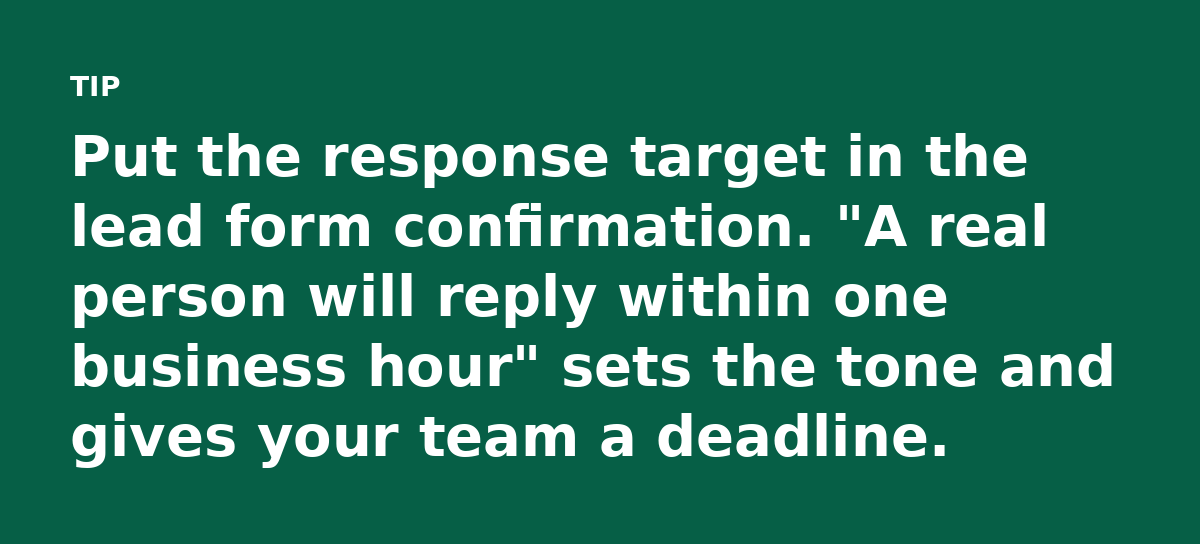
Response time still decides who gets the meeting. Research reported in Harvard Business Review found that firms contacting a lead within an hour are nearly seven times more likely to qualify it than firms that wait another hour. The same rule holds when an agency downloads your security guide or scans a badge at a conference.
Route inbound interest to a named owner and set a one-hour response target for business hours. If the person is not the right contact, reply anyway and ask for the program lead.
Mistake 6: One follow-up, then silence
A 12-month buying cycle does not respond to a three-email sequence. Budget seasons shift. Priorities change after an election or a new agency director.
Build a long, useful cadence. Send funding updates and short case notes from similar agencies. Aim for eight meaningful touches across a year, each teaching the buyer something.
Track replies by topic. A question about FedRAMP is a stronger signal than an email open.
Mistake 7: Trusting stale contact data
Government contacts move. A new administration, a retirement, a reorg or a promotion can wipe out half your list in a quarter. Generic inboxes like info@ get ignored or routed to a queue.
Verify names and roles every 90 days. Check the agency staff directory and the procurement office page. Keep a source note for each contact so you know when it was last checked.
One accurate program manager beats 200 scraped addresses.
Mistake 8: Hiding your compliance proof
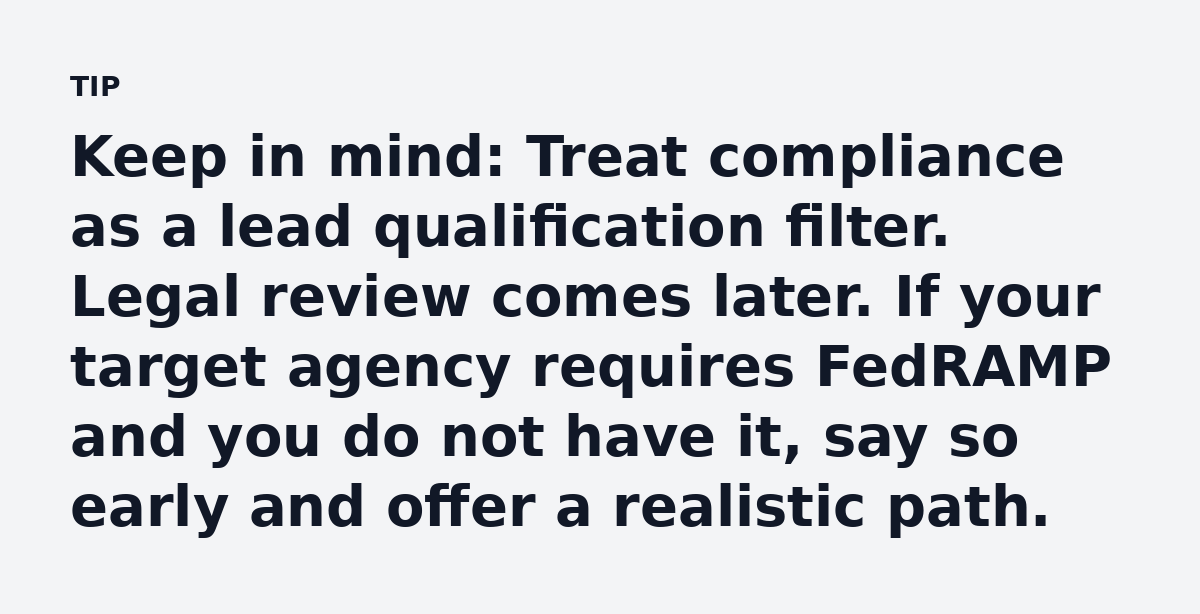
Public buyers must check security and compliance before they can shortlist you. FedRAMP, StateRAMP, SOC 2 and ISO 27001 reports often decide whether a demo happens at all.
Put the proof where a buyer can find it. Link your status page from the pricing page and from every proposal. State plainly which approvals you hold and which are in progress.
A missing document can stall a deal for months. A clear status page removes a silent objection.
The number to track instead of lead volume
Count qualified buying paths. Marketing qualified leads are a weaker number. A buying path has a named agency, a known budget cycle, a route to contract and a champion who answers email.
Here is the math. Suppose your average contract is $80,000 and your goal is $800,000 in new public sector revenue. You need 10 wins. At a 20 percent close rate, you need 50 qualified opportunities. If each opportunity takes four months to surface, your marketing plan needs to produce about 13 new qualified paths per month.
That math changes the daily work. Instead of chasing 500 downloads, the team builds 13 real conversations with agencies that can buy.
Your reset for B2G lead generation
Start with one agency you already serve or want to serve. Map its budget calendar, its preferred contract vehicle, its procurement office and the program owner. That single map will teach you more than another list purchase.
Then apply the four-point filter to every new lead.
Give inbound interest a one-hour owner and build a cadence for long-cycle leads. Check contact data every quarter and publish your compliance status.
The one thing to do next
Write down the exact path from first conversation to signed contract for your chosen agency. Without the budget year and the vehicle, you have only a name.
Need this run for you? See the outreach service.