
Businesses set up competitor price tracking and then watch it fail for the same handful of reasons. The tool is rarely the problem. The inputs usually are.
Key Takeaway
Competitor price tracking pays off when you narrow it to the SKUs that decide your profit and compare the price a customer actually pays. Get both right and the software choice matters far less than sellers assume.
Here are the mistakes that quietly cost money, plus the setup that replaces them.
Mistake 1: Tracking your whole catalog
Pulling 4,000 SKUs into a monitoring tool produces 4,000 rows a week and zero decisions. Nobody reads that.
Narrow the list. Start with the 20 to 30 products that drive most of your revenue or that a rival could copy in a weekend. If you sell 4,000 items, the other 3,970 do not change your pricing decisions.
Twenty-five SKUs checked twice a week comes to 2,500 checks a year. A person doing manual spot checks gets through maybe 300 of those. You already know which 300 matter.
Mistake 2: Comparing sticker prices while they run a sale
Your competitor shows $45. Their cart charges $38 because of a 15 percent promo code that auto-applies at checkout. Your $45 now looks expensive when nothing about your pricing changed.
Track the price a customer would actually pay. That means the promo and the shipping charge. Most tools let you record a checkout-tested price. Use it.
Mistake 3: Ignoring shipping and bundles
A $9 lower sticker price can lose after shipping. If they charge $6 flat and you charge $12, their real advantage is $3, not $9.
Write one line next to every tracked SKU: landed price to the customer. It takes ten minutes and it ends most false alarms.

Mistake 4: Setting alerts tighter than your margin can handle
A one percent alert is noise. A one percent gap on a $45 item is 45 cents and will not change what a buyer does.
Work out your walk-away price first, then set the alert below it. If your cost on a product is $18 and you want at least $12 of gross profit per unit, your floor sits at $30. A competitor at $29 is not your problem. A competitor at $38 might be.
The margin math behind a price cut
Say you sell at $45 with $18 in cost. That is $27 of gross profit per order. A competitor drops to $42.
Holding the same dollar profit now means selling 45 divided by 42, which is 1.071. You need roughly 7 percent more orders to earn what you earned before. On a store running 300 orders a month, that is 21 extra orders to stand still.
That number is the one to remember. A small price cut asks for a large volume lift and volume lifts show up in your analytics days later.
Mistake 5: Reacting in the same hour
You see a rival cut price at 9am and you match it before lunch. You had no idea they were running a clearance on old inventory or testing a promo that ends Friday.
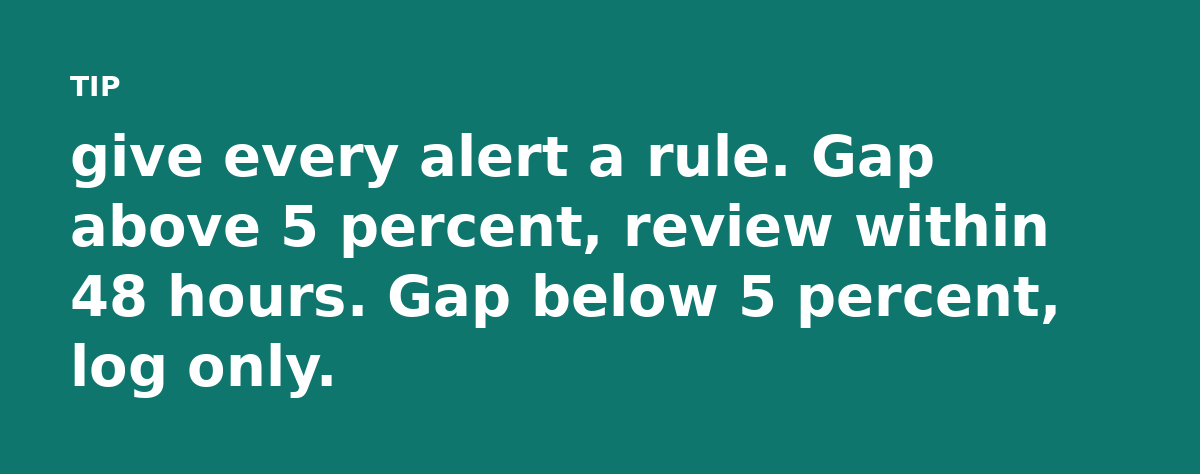
Set a response window. Two to four business days is normal for most catalogs. Match inside the window if the gap hits your threshold. Ignore everything else until the data settles.
Mistake 6: Treating one snapshot as a trend
A single check tells you almost nothing. Price moves bounce. A competitor may raise for two weeks and then drop below you for a day.
Require three checks across two weeks before you call something a pattern.
Mistake 7: Changing your own price first, then blaming the market
You raised prices for a promotion in March. By June your conversion rate is down and a competitor looks aggressive. Nothing about them changed.
Compare trend to trend. Their price last quarter against this quarter. Your price last quarter against this quarter. If yours moved first, the shift is internal.
Mistake 8: Filing the data where nobody opens it
A spreadsheet saved to a folder is a graveyard. The same data pasted into the channel you already read every morning survives.
Put the alerts there too.
What a working setup looks like
Four inputs. That is the whole system.
- Watch list: 20 to 30 SKUs that carry your profit
- Frequency: twice a week for most stores, daily for your top five
- Threshold: the gap where a match still pays, worked out from your own cost
- Owner: one person who decides, plus a response window
Run the gap formula on each watch-list item once a quarter. Price gap equals competitor price minus your price, divided by your price, times 100. A negative 6.7 percent means they are 6.7 percent under you.
Match only where the gap is wide enough to matter and small enough to survive.
Your first 30 minutes
Open whatever spreadsheet or tool you have.
Then compute your walk-away price for the top five. Cost plus the gross profit you insist on.
The one thing to do tomorrow
Pick a single SKU and run the margin math out loud.
Fewer alerts means fewer reactions and your margin survives the quarter.
Read the full guide: How to Track Competitor Prices on Shopify Stores: A Practical Checklist