
Key Takeaway
Your scraper gets blocked because the IP address behind it already carries a bad reputation. This piece explains how IP reputation scoring works and what to change so your job survives long enough to finish.
The first request decides more than you think
You point a scraper at a page and the first ten requests return clean HTML before the wall goes up. Most people blame the parser when the real answer sits in a database you will never see.
Every IP address carries a reputation score and websites check that score before they look at your headers. A fresh datacenter IP from a large cloud provider often arrives pre-flagged, so you start from behind.
What the scoring engines actually read
Reputation scoring tries to predict one thing: is this request from a person or a script? The score pulls from a handful of signals and four of them matter most.
- ASN and the owning network. Requests from AWS or Google Cloud are easy to tag. The ASN says hosting provider, not home broadband.
- Geolocation consistency. If the IP claims Germany while the browser language and timezone point to California, something looks wrong.
- Request history. An address that hit 500 pages in ten minutes looks like a bot and so does one that failed fifty logins last week.
- Shared misuse. Proxy pools are shared, so if another user used your exit node for spam the penalty lands on you too.
According to public reports, IPQualityScore and MaxMind are among the vendors that sell these scores while Cloudflare builds its own. The exact math stays private, but the inputs do not.

Why datacenter proxies fall on day one
Datacenter proxies are fast and cheap, but they live in ranges that security teams memorize. Thousands of bots share the same subnet, so when a few misbehave the whole range inherits the damage.
Picture a US datacenter IP leased from a major host. It has no browsing history and no residential footprint, so it shows up on public ban lists that maintainers refresh by the hour. A site can block an entire /24 and never touch a real visitor.
That does not make them worthless. For public APIs with light defense they work fine; for a login-gated site with a challenge page they tend to fail within minutes.
How residential addresses change the math
Residential proxies route traffic through real consumer connections. The ASN looks like a cable or mobile provider and the location matches the device, which buys you time.
A scraper that stays unnoticed long enough to collect the data wins, while one that trips a challenge on request twelve walks away empty.
Residential addresses are no free pass: they cost more per gigabyte and still get flagged when abused. The advantage is a cleaner starting slate.
A rough risk formula you can use today
Before you scale a job, estimate the block risk of the pool you plan to rent. It does not need to be precise, because a rough number will steer the decision.
Risk = ASN type + geo mismatch + request velocity + shared history
Score each factor from 0 to 5. A hosting ASN scores high while a matching residential ASN scores low. A geo mismatch adds points and high velocity adds more. A pool with known abuse history adds the rest, so anything above 12 means you should slow down or swap the pool before launch.
Field notes from jobs that quietly died
One team scraped a retailer with 200 concurrent threads on fifteen datacenter IPs and they were blocked within four minutes. Dropping to two threads on residential IPs doubled the runtime and finished the catalog.
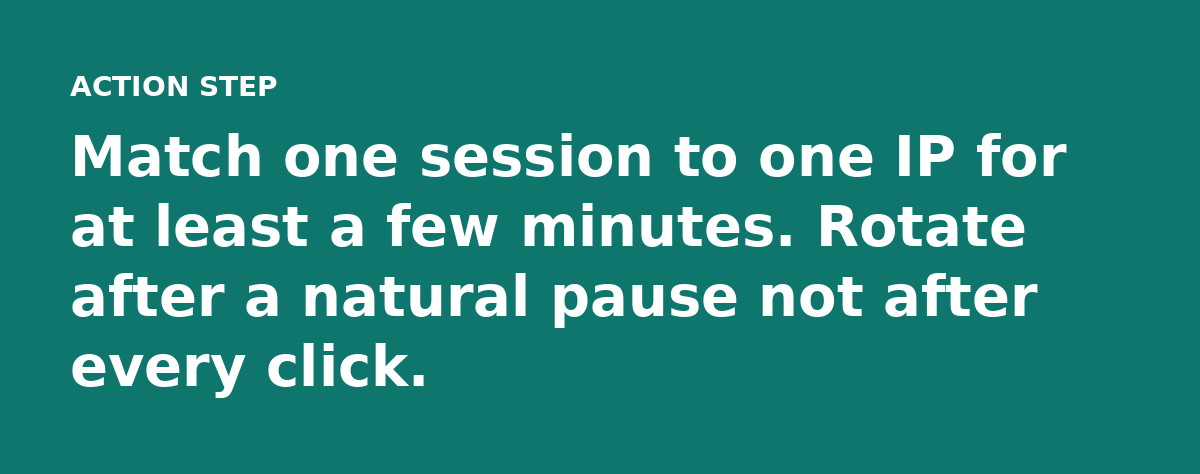
Another team rotated a fresh IP on every request and that trick backfired. Rapid IP changes across unrelated ASNs look exactly like an attack, so the site served captchas to everything from that session range.
The pattern repeats. Consistency and patience keep you alive and a steady session that mimics one person browsing beats a blast from a thousand addresses.
How to choose a proxy that lasts
Start with the target and check how aggressive its defense is. A static content site needs far less cover than a ticketing platform.
- Prefer residential or mobile IPs for gated pages and logged-in workflows.
- Keep datacenter IPs for public endpoints where speed matters more than stealth.
- Match the exit country to the content you want. Local IPs pull local prices and local inventory.
- Test a small pool first, run 100 requests and count the challenges and 403s before you buy a large plan.
Track two numbers per pool: the challenge rate and the average requests before a block. Those tell you more than any vendor pitch.
The habit that saves your next project
Add a pre-flight check to every scraping job. Send a single request through each proxy and log the response. If a pool fails the check, do not launch; this one step costs a few seconds and prevents a wasted overnight run.
Treat your IP pool like a scarce resource and it will carry you much further than raw speed ever will.
Read the full guide: Bot Detection Signals: Why Your Scraper Gets Blocked While You Sail Through