
North Trail Signed Up in Twenty Minutes
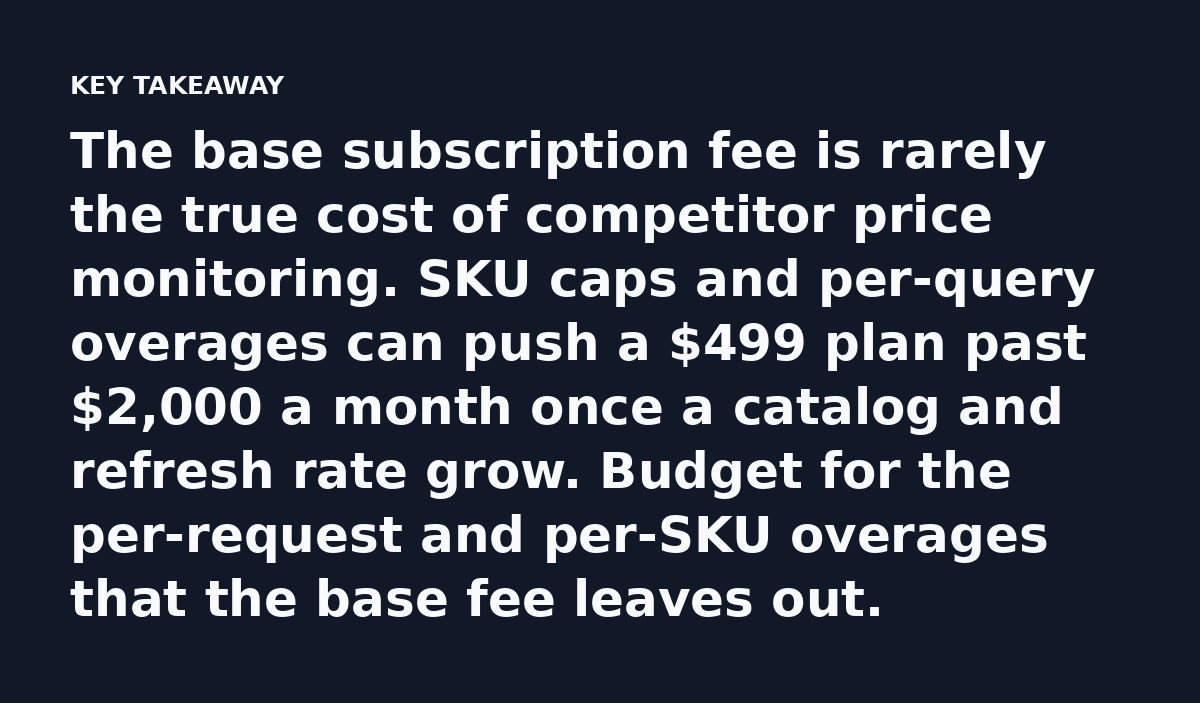
North Trail Supply sells outdoor gear and carries 4,200 active SKUs. The pricing lead wanted multiple daily price checks against four rivals. A rep quoted $499 a month. The trial looked clean, so the team signed the same afternoon.
Thirty days later the card was charged $2,180, the difference between the advertised plan and what the store actually used.
The Demo Skipped the Fine Print
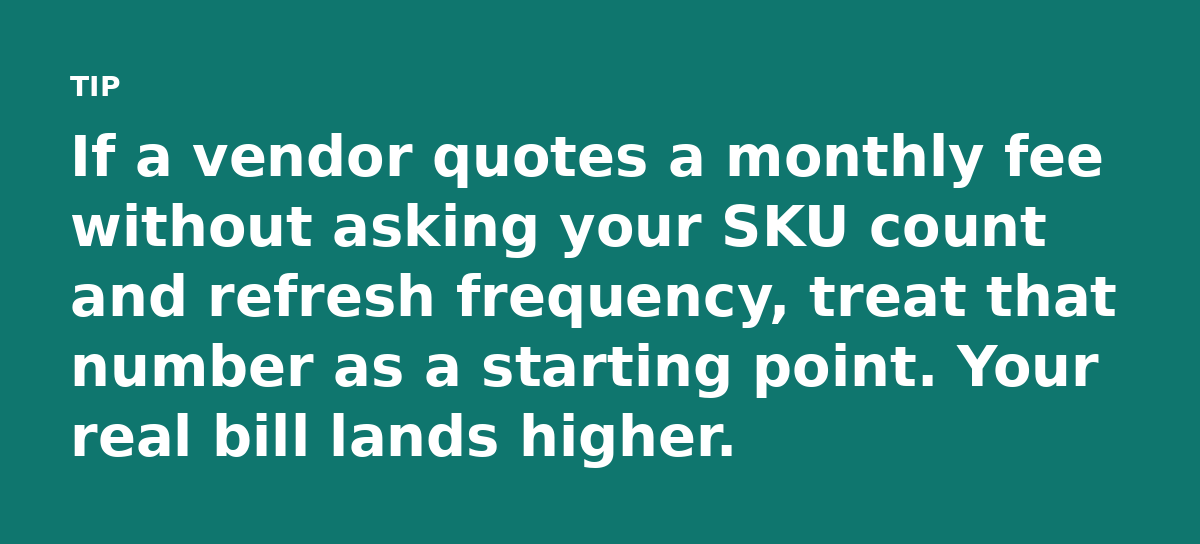
The platform tracked prices well, but the real cost lived in contract terms a sales demo does not show.
A one-time onboarding fee sat on page four. The monthly SKU cap and the API request limit sat further down.
The Onboarding Fee
North Trail paid a $2,500 onboarding fee the vendor labeled professional services, covering feed setup and a product matching pass.
Buyers often file onboarding under one-time costs and forget it. At scale it is a real budget line. A messy product feed can run $4,000 or more when the vendor bills by the hour or by category count.
Product matching eats the hours
Matching maps your SKU to a competitor’s product page. Skip it and you compare a 2-person tent against a 4-person tent. The dashboard then reports a price gap that does not exist and someone makes a bad pricing call.
SKU Caps Set the Monthly Floor
North Trail’s plan covered 2,500 SKUs. The store carries 4,200. The extra 1,700 SKUs cost $0.15 each per month.
That is 1,700 x $0.15 = $255. A 51 percent jump on top of the base fee, before any API charges appear.
Vendors sell tiers rather than flat plans. One tier might cover 1,000 SKUs at $199, the next 10,000 at $899. Often the higher tier costs less than paying overage on the lower one.

How the API Meter Works
Every SKU and competitor pair needs its own request. Refresh more often and the count climbs. A daily refresh across a few thousand SKUs reaches six figures in a month without much effort.
North Trail’s plan included 250,000 requests. The store used 963,000. The 713,000 overage requests billed at $0.002 each, adding $1,426.
The Formula That Predicts the Bill
Drop real numbers into one line to estimate the bill.
Monthly cost = base fee + (tracked SKUs minus included SKUs) x per-SKU rate + (monthly requests minus included requests) x per-request rate.
North Trail’s math: 499 + (4,200 minus 2,500) x 0.15 + (963,000 minus 250,000) x 0.002 = 2,180.
Divide by SKUs to see the honest rate. That is 2,180 divided by 4,200 or $0.52 per SKU each month.
What North Trail Changed
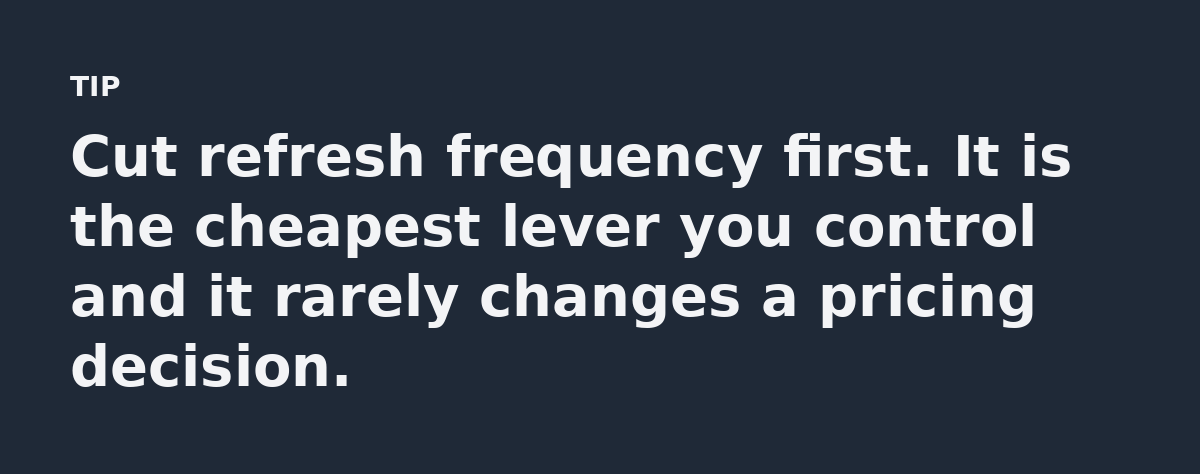
The team kept the tool but cut two settings. Refresh dropped from four times a day to one overnight pass and tracked competitors fell from four to two, the ones that actually cost or won sales.
New request load: 4,200 SKUs x 2 competitors x 1 refresh x 30 days = 252,000. Just above the included 250,000, so the API overage fell to roughly $4.
New monthly total: 499 + 255 + 4 = $758. The per-SKU rate dropped from $0.52 to $0.18.
What to Ask Before You Sign
- How many SKUs are included and what is the overage rate per extra SKU?
- How many API requests are included and how does the vendor count one request?
- Is onboarding a fixed fee or billed hourly?
- What refresh frequency does the quoted price assume?
Get each answer in writing. Verbal quotes do not survive a billing dispute.
A quick gut check
If the vendor cannot state the per-request rate in one sentence, treat that as a warning sign.
The One Number to Nail Down
Before you sign, calculate your monthly request count. Multiply SKUs by competitors by refresh frequency by 30. Compare that total to the included limit.
If it clears the limit, you already know your real bill.
Read the full guide: What a Competitor Price Monitoring Service Really Costs and How to Budget for It