Why Most Government Leads Go Cold
A city IT director downloaded your security guide. Your CRM marked it hot. Your rep called twice. Silence.
That contact was a signal. The budget owner decides when it becomes a lead. Government buyers work through approvals. They answer to procurement staff. A download often starts a conversation that runs a year.
New vendors commonly see 12 to 18 months from first touch to signed contract. Most follow-up sequences last two weeks. Close that gap and your pipeline changes.
Step 1: Put the Money Calendar on the Wall
Federal agencies close their fiscal year on September 30. Many state and local governments start theirs on July 1. Money moves around those dates.
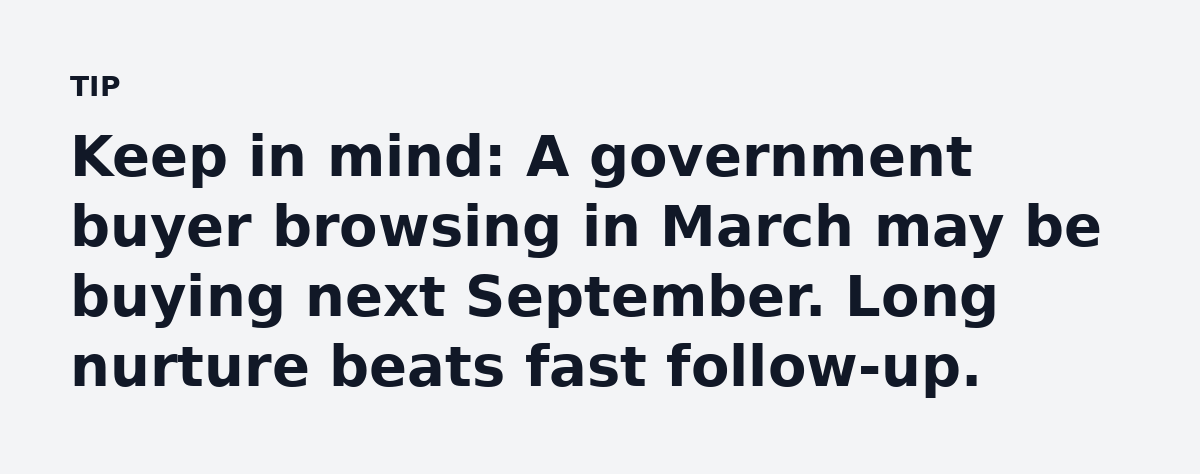
Budget drafting happens months earlier. That is when your champion collects vendor research. A report saved in February can resurface in a procurement file in October.
Example: a software vendor selling to counties moved its main webinar from November to February. Attendance from county budget staff doubled. Same content. Better timing.
Step 2: Define a Qualified Lead in One Sentence
Write the definition. Make sales sign it. Vague definitions create fake pipeline.
Here is a usable standard: a named contact at a target agency who has confirmed a planned purchase within the next two budget cycles and can name the contract vehicle they expect to use.
Notice what is missing. Job title alone means little. A director without budget influence is a contact, not a buyer.
The Lead Score Formula
Use a simple score. Agency fit from 0 to 3. Role authority from 0 to 3. Research engagement from 0 to 4. Route anything at 7 or above to a human.
A fire chief who attends a 45-minute webinar scores higher than a generic inbox that clicked your link. That difference matters.
Step 3: Build Assets a Champion Can Forward
Most public employees cannot accept a vendor lunch. They can forward a document to a finance director. Build for that move.
Useful assets include a cost comparison sheet, a compliance checklist, a recorded demo with captions and a one-page budget justification memo. Four formats. Each one gives your champion cover.
Put “budget justification” in the asset title. Government staff search for that phrase when they build a purchase request.
Step 4: Score Fit Before Interest
Open rates lie. A police department IT manager who opens your newsletter five times still cannot buy your HR platform.
Score agency match first. Then score the person. Then score the behavior. Reverse that order and your reps chase curious browsers.
Set a hard cutoff. Below it the contact stays in marketing. Above it a rep gets a task with the full context attached.
Step 5: Nurture on Their Clock
Build a 12-month track tied to budget milestones. Send one useful piece each quarter. Skip the holiday cards.
A workable sequence: a research report in January, a peer webinar in March, an implementation checklist in May and a contract vehicle explainer in August. Four touches. Each one helps the buyer do their job.
The contract vehicle explainer often gets the highest response. It answers the question procurement will ask later.
The objection: “Government deals take too long to matter this quarter.” Fair. Run two tracks. One track works agencies spending now. The other works agencies drafting next year’s budget. The second track looks slow until it becomes your only reliable source.
Step 6: Hand Sales the Procurement File
A name and an email is not a handoff. Give the rep the agency, the budget stage, the expected contract vehicle and the champion’s internal obstacle.
Train one question: “Which contract vehicle are you planning to use?” Buyers with an answer are moving. Buyers without one are still learning.
Step 7: Measure Deals That Survive Procurement
Track four numbers. The share of leads that reach a named budget owner. The average days from first touch to RFP. Win rate by contract vehicle. Sourced revenue by agency.
Dump the MQL dashboard. A hundred MQLs that never reach procurement is noise with a chart.
Review those four numbers monthly with sales. Fix the weakest one first.
The One Number to Watch
Qualified government conversations per quarter. Define it as a call with a named budget owner where a purchase timeline gets discussed. Count it weekly.
That number predicts revenue better than downloads. It also exposes weak content fast. If webinars do not create conversations the topic is wrong.
Your Move This Week
Pull your last 20 government-domain leads. Tag every one that has a named budget owner. Most teams find fewer than five.
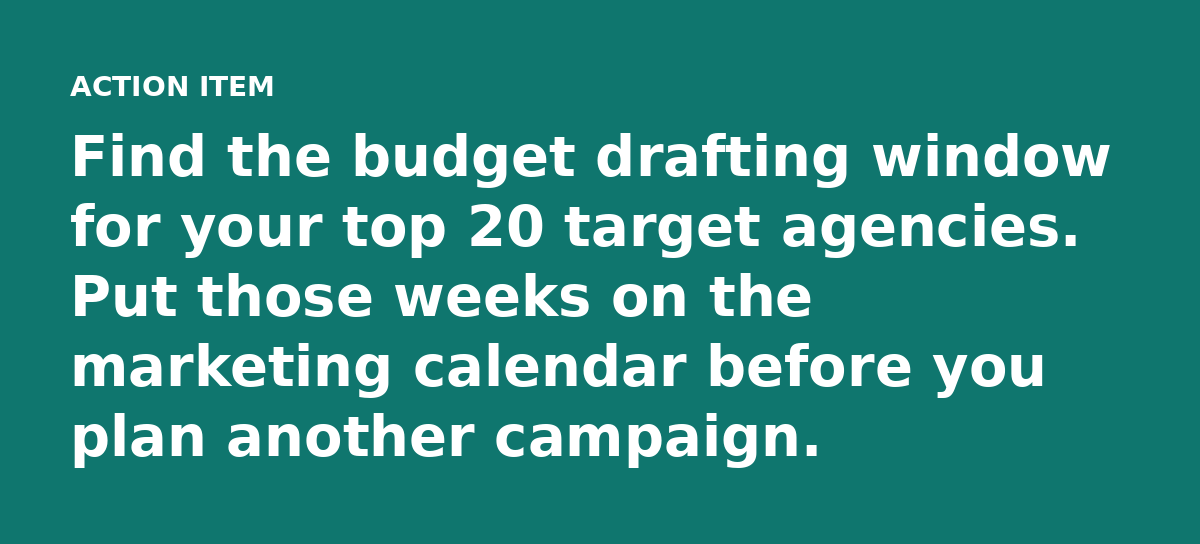
Then rewrite your lead definition and send it to sales. Add a budget justification one-pager to your top gated asset. Put next year’s budget drafting window on the calendar.
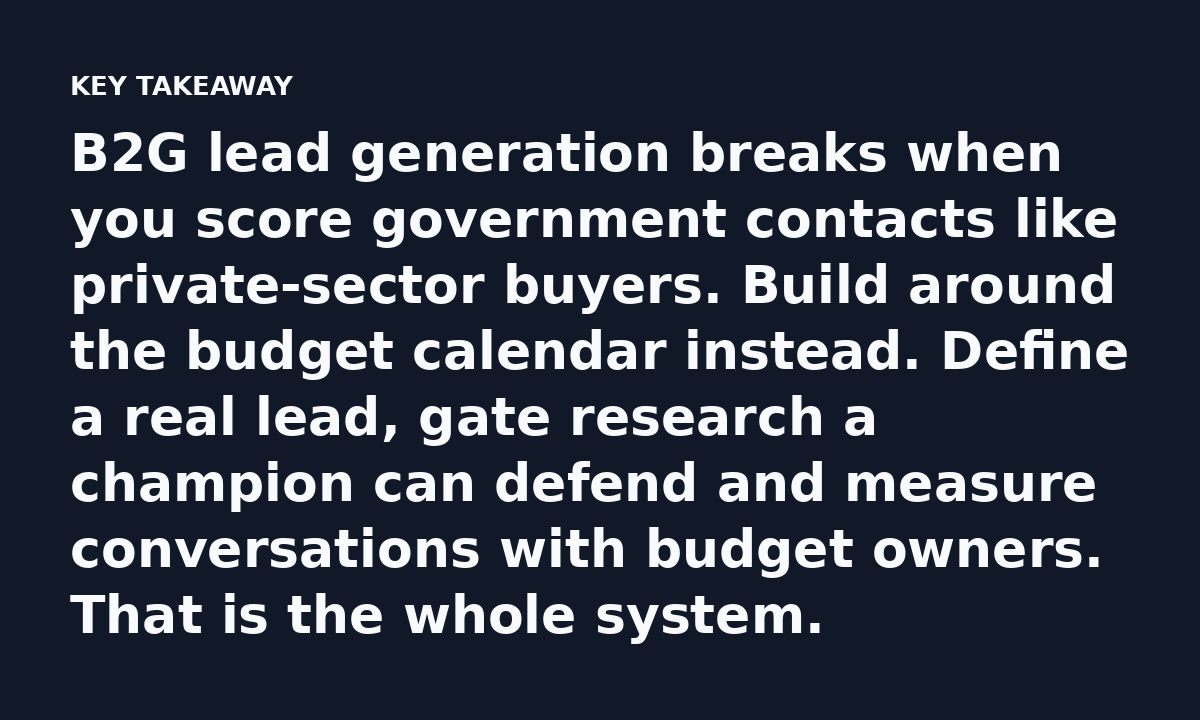
B2G lead generation rewards patience and precision. Pick the agencies that fit. Learn when they spend. Give their champions something they can defend. Then let the calendar do its work.
Need this run for you? See the outreach service.