Key Takeaway
DIY content writing looks free. It is not. The bill shows up as hours you never billed and deals you never had time to chase.
Add the research and the rewrites together and one “free” article can cost more than paying a writer. Here is how to count it and how to stop the leak.
What does a DIY article really cost?
Most owners count only the writing time. That number is the smallest part.
Say you want a 1,200-word blog post. Here is a real breakdown from how this work actually runs:
- Research and reading: 1.5 hours
- First draft: 2.5 hours
- Editing and fact checks: 1.5 hours
- Formatting and links: 0.5 hours
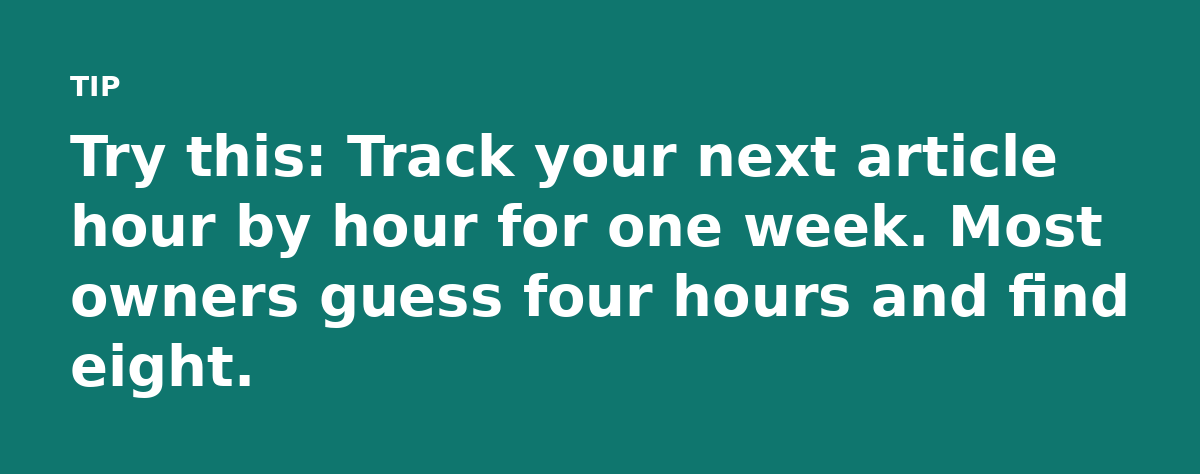
That is 6 hours. If your time is worth $75 an hour, the article just cost you $450.
Why does editing eat more time than writing?
The first draft is where the ideas fall out. The edit is where you fight them into shape.
A typical piece goes through two or three passes and each pass pulls you back to the same screen while nothing new gets published.
Writers have a name for this trap. They call it the perfection loop. You fix one line, then the next line looks weak by comparison and you fix that one too.

What is opportunity cost and why does it sting?
This is the cost nobody writes down. While you are drafting, you are not closing.
Picture a service business where one closed deal is worth $2,000. You spend two of those writing hours on a blog post and miss a lead email, so that lead goes to a competitor.
The article cost $450 in labor and the missed deal cost $2,000, so your “free” post just became a $2,450 expense.
How to put a number on it
Use this simple formula:
True cost per article = (writing hours + research hours + editing hours) x your hourly rate + opportunity cost
Run it once on your last piece.
How do I know if writing my own content is worth it?
Ask one question. Does this article earn more than the work I skipped to write it?
For some people the answer is yes. A founder with deep expertise and a slow sales cycle can win trust fast with first-hand stories. That content is hard to hand off.
For most operators the answer is no. The costs outweigh the gains the moment the writing time replaces billable work.
When should I stop writing it myself?
Hand it off when the task repeats. If you write one post a month, keep it; if you need four or more, the math flips.
You also gain consistency. A writer who sends the same brief every week produces the same shape of article. A busy owner produces a burst in January and nothing in March.
There is a second gain. Fresh eyes catch the mistakes you stopped seeing. You know your product too well to spot the missing context a stranger needs.
How do I make my own writing faster if I keep it in-house?
Cut the research loop by building one source file for your topic with your facts and numbers. Pull from it instead of hunting the web each time.
Write the outline in five bullet points first. If the outline is thin, no amount of drafting will save it.
Then set a timer and give the draft 90 minutes and the edit 45; when the timer rings, you publish.

What is the real upside of fixing this?
Fixing this gives you back six hours a week, a full working day.
Spend it on sales calls and follow-ups, work that puts your hours where they earn the most.
The one thing to do next
Take your last three articles and estimate the hours, then multiply by your rate. Add what you did not sell while writing.
If that number tops what a writer would charge, you already have your answer. Start with one outsourced post, compare the quality and the hours you saved, then decide.
Read the full guide: Done For You Content Writing Service vs DIY: The True Cost Per Article