
Key Takeaway
A content writing rate is a price for work you cannot see. Two quotes that look far apart can cost about the same once you add your own review hours.
Below is how each pricing model really works, plus the one number that tells you which quote to take.
The quote that looked like a steal
Marisol runs a 12-person landscaping company outside Phoenix. She wanted eight blog posts for a spring campaign. Her first quote came back at eight cents a word.
A 1,500-word post worked out to $120. The second writer quoted forty cents a word or $600 for the same length. She picked the $120.
Two weeks later the posts were live. Each one took her about five hours to fix. Missing sources. A keyword she never asked for stuffed into the first line.
Her time runs $45 an hour, so five hours is $225. Add the $120 she paid and that post cost $345.
The $120 post was never a $120 post.
Why the numbers never line up
Per-word pricing pays for output. The writer gets paid whether the sentence teaches the reader anything or not. Hourly pricing pays for time, so a slow writer can bill more than a fast one for the same page.
Retainers run on a different logic. You reserve a chunk of someone’s month and the work flexes around your calendar.
They are competing scopes.
Where the money leaks
Quotes you cannot compare
A per-word quote and an hourly quote use different units. They cannot sit in the same row of a spreadsheet without a conversion. If a writer charges $75 an hour and finishes a 1,000-word post in three hours, that post is $225. If another charges 20 cents a word, the same post is $200. Now they can be weighed.
Buying words when you need a result
Words are an input. A writer paid by the word has a quiet reason to add length. So agree on what the post must achieve, then price the outcome. You are buying a page that ranks and convinces a buyer to call. The word count is a detail.
The retainer with no edges
Retainers feel safe because the price is fixed. The risk hides in the scope. “Ten hours a month” means nothing until you define what counts as a deliverable. One small firm paid $2,000 a month and received two short emails. Written out, that was $1,000 an email.
Your own hours are never free
This mistake has the widest gap. Owners price a quote and forget the time they spend reading and chasing. Spend four hours a month on a $500 retainer and your time at $60 adds $240. The retainer really costs $740.
Price per word hides the real number
A cheap rate on a post you cannot publish is a refund you have not asked for yet.
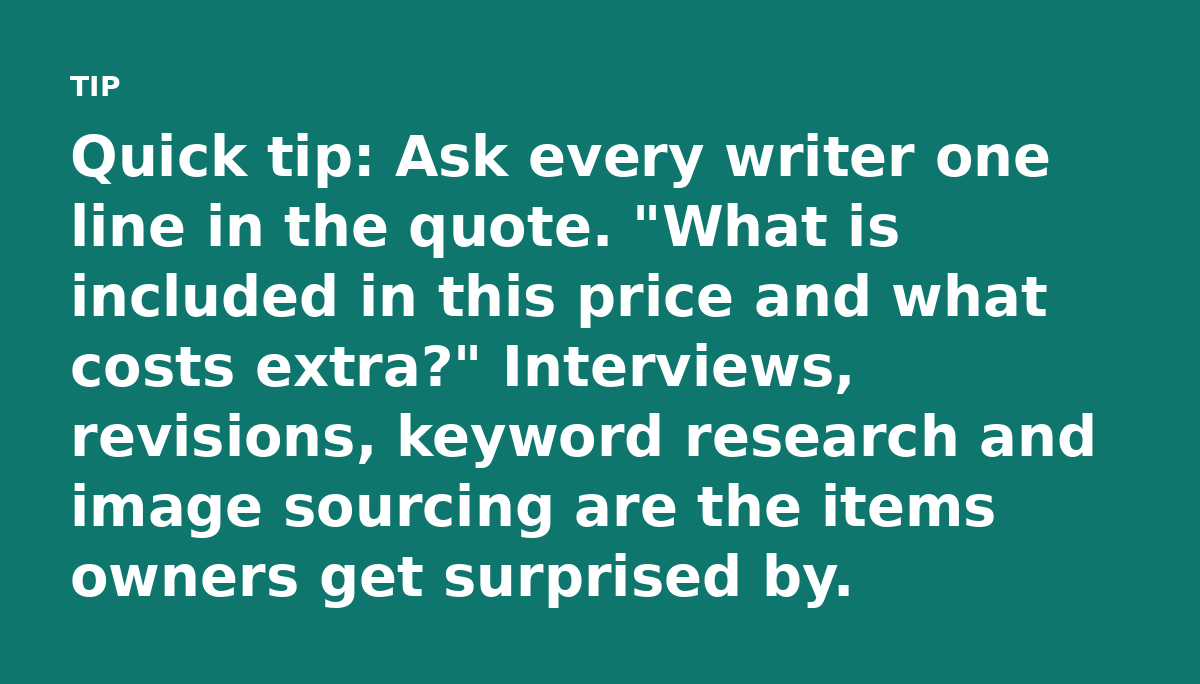
The one conversion that matters
Stop comparing rates. Compare the cost of a post you can publish without touching it.
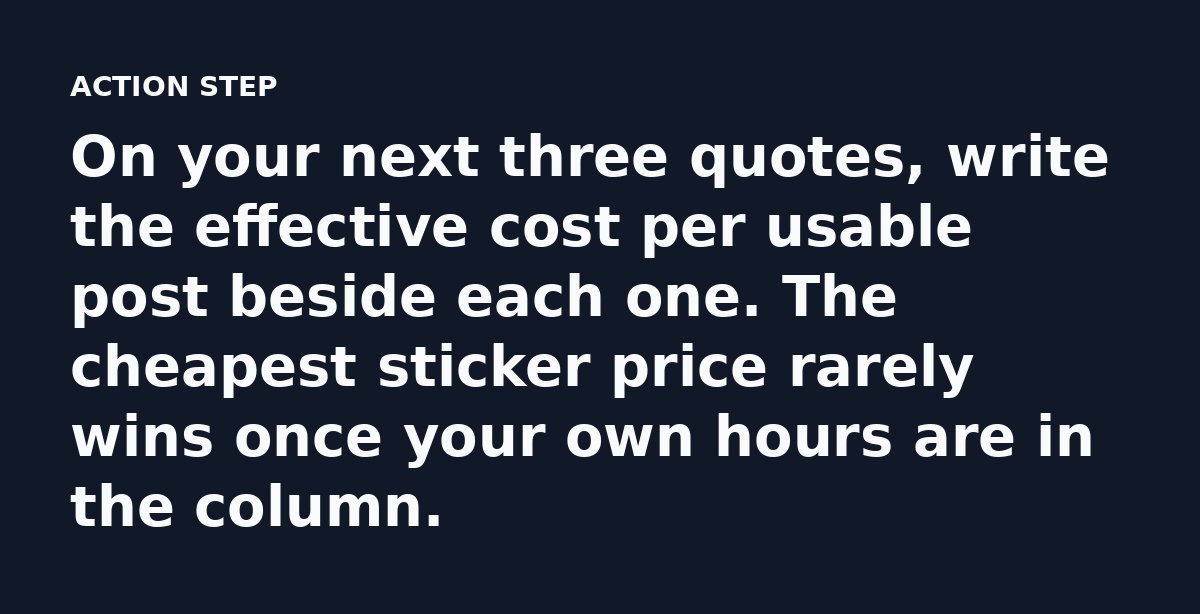
Effective cost per post = (writer fee + your review hours x your hourly value + rework costs) / posts published with no rewrite
Run the numbers
Writer fee $120. Her time, five hours at $45, is $225. Say she rescued four of the eight posts. The effective cost is ($120 x 8 + $225 x 4) / 4. That equals $465 a post.
The writer quoting 40 cents a word delivered at $600 a post, ready to publish. On paper the cheap writer was 80% less per word. After the math, the gap was 22%. Four posts were a total write-off.
What to do before you send the next brief
Pick the model for the job. Need a steady drumbeat of posts and you have no time to manage a writer? A retainer with a written scope works. For one hard-hitting page, an hourly or project rate often fits better, since the writer can invest in research without padding the word count.
Then do one thing before you reply to any quote. Estimate your own review hours and multiply by your hourly value. Add that to the fee.
That final figure is the real content writing rate.
Read the full guide: Content Writing Service Pricing: 9 Things Nobody Tells You Before You Buy