
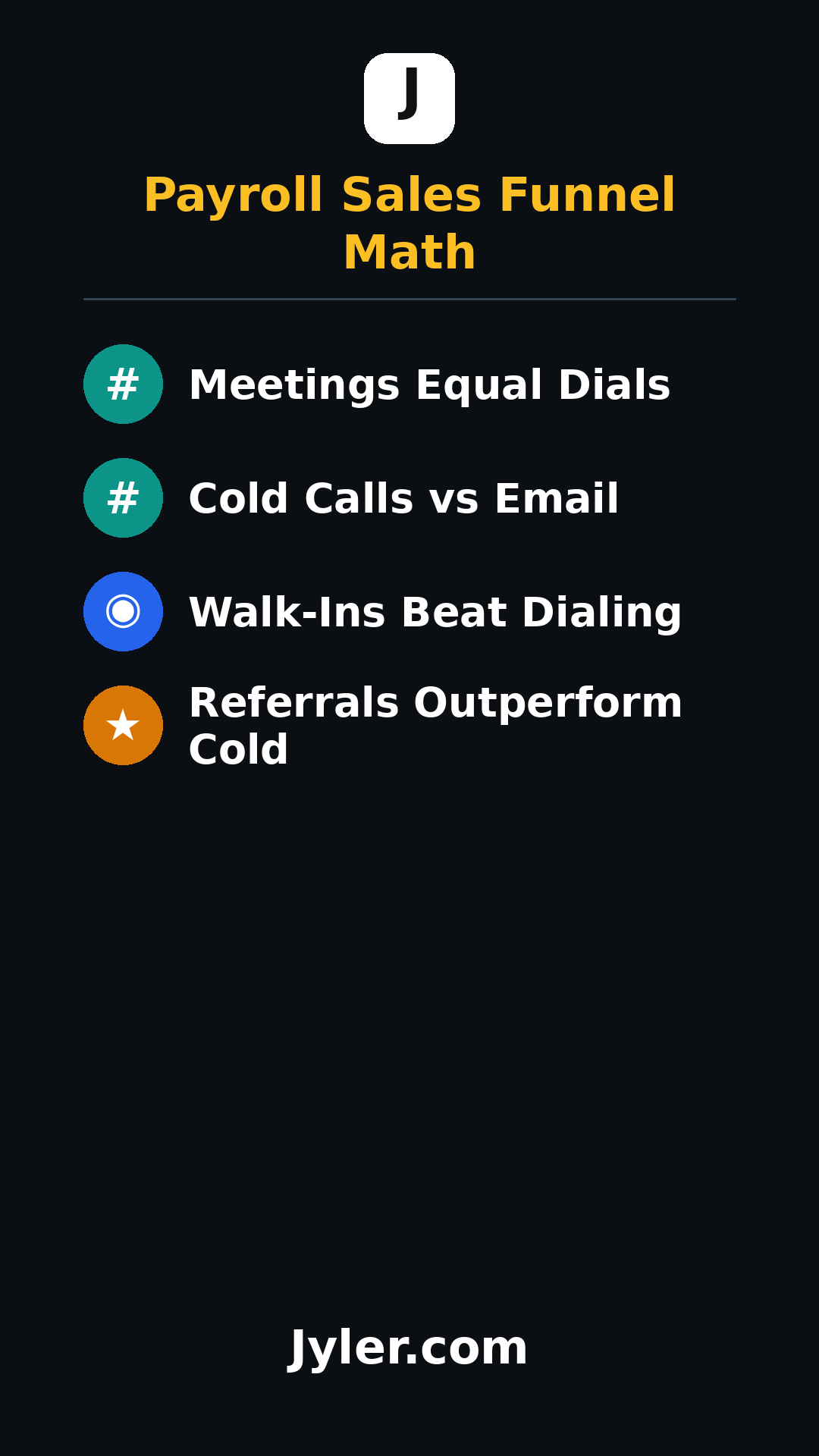
Key Takeaway
Booking 5-8 meetings a week in payroll service sales comes down to funnel math. The reps who hit that number treat their calendar like a production line. They know the dials and replies each meeting costs, then they repeat the input that works.
This is a comparison of the channels that fill a week and the ramp you should expect before the numbers look real.
The Quota Is Arithmetic
Start with one formula. Meetings per week equals outreach volume multiplied by connect rate, then multiplied by the rate at which a conversation becomes a booked meeting.
Say you make 150 dials in a week. You reach a live person on 8% of them. That is 12 conversations. If 4 of those turn into meetings, you just booked 4. To reach 6, you either raise the connect rate or add dials.
At a 4% connect-to-meeting rate, 6 meetings costs roughly 190 dials. That is 38 a day across a five-day week. Nothing heroic. It is a number you can plan around.

Cold Calls vs Email: Which Channel Fills the Week
These two behave nothing alike and should never share a target.
Cold calls connect somewhere between 5% and 10% of attempts on a good list. Email replies land closer to 1% to 3% and most of those are “not now” rather than “book me.”
The comparison matters because email scales volume while the phone scales certainty. A rep sending 400 emails a week might get 8 replies and 2 meetings. A rep making 200 calls might get 10 conversations and 5 meetings.
Run both, but count them separately. One channel builds pipeline depth. The other closes the gap when the week is thin.
In-Person Visits vs the Phone in a Local Territory
A town of 250,000 with a dense small-business base changes the math. Walking into a business gives you a shot the phone never does.
A face-to-face stop often reaches the owner or office manager directly. That is a much higher connect rate than dialing through a gatekeeper. The trade is speed. You might complete 15 visits in a day versus 40 calls.
For payroll, the walk-in wins when the decision maker is on site. It loses when they are not. Plan routes around business hours and cluster stops by neighborhood to cut drive time.
Referrals vs Cold Outreach
Referrals convert far better. A warm introduction can close at 20% or more, while cold outreach often books at 2% to 5%.
The catch is supply: referrals arrive slowly at the start, while cold outreach you control. Build referrals as a compounding asset in month one.
What a 25-Person Deal Size Tells You
Smaller deals mean shorter cycles and more of them. A 25-person company is a fast decision. Fewer stakeholders, quicker yes.
That is good news for the 5-8 target: steady flow matters more than long enterprise courtship. If your close rate on booked meetings is 25%, then 6 meetings a week produces about 1.5 new customers weekly.
Over a quarter that is roughly 18 accounts. At a realistic per-account value, you can check whether the territory supports the goal before you accept the job.
Positioning the 25% Cost Savings
A cheaper price and better support are the reason to switch once interest exists.
Lead with the pain: payroll errors, poor response when something breaks. Then use the savings as proof the switch is safe.
Compare the incumbent’s support to yours with one question. “When something goes wrong at month end, who picks up the phone?” If they hesitate, you have your opening.
The Ramp Reality: Early Weeks vs Week Twelve
Do not judge the role by week two. Early weeks are list building and rejection. Meetings come slower while you learn the territory.
By week eight to twelve, patterns show up. You know which streets answer and which objection repeats. That is when 5-8 becomes normal instead of a stretch.
Your Action Plan for This Week
Set a daily dial target that matches the math. If you need 6 meetings and your ratio is 1 in 30, that is 180 dials. Split them into morning and afternoon blocks.
Block two hours a day for in-person visits in one tight area. Cluster the stops so travel does not eat your day.
Ask for one referral after every conversation, including the ones that end in no.
Review your dials and connects each Friday. Adjust the input when the goal is missed.
The job is real and the number is reachable with a plan.
Watch the 30 second summary
Video transcript: Meetings per week is just arithmetic. Volume times connect rate times your booking rate. Six meetings at a four percent rate costs about 190 dials, only 38 a day. Cold calls connect at five to ten percent. Email replies land closer to one to three, mostly not now. Run both, but count them separately. Phone scales certainty, email scales volume. In a dense local territory, walking in reaches the owner directly. That beats dialing through a gatekeeper. You get fewer touches but far higher connect rates, so cluster your stops by neighborhood. Referrals close at twenty percent or more, cold outreach books at two to five. Referrals arrive slowly, so build them as a compounding asset from month one while cold keeps you busy.