A900-word blog post from a decent writer runs about $180 to $400. A subject matter expert with credentials runs $600 and up. That gap is the whole decision.
Key Takeaway
Most owners who hire a done-for-you content writing service complain about price when the real problem is the handoff. You have to write the brief, not the draft. Get that one document right and the cost stops being the story.
This piece walks through how to scope a content writing project, what the market actually charges and how to tell a cheap writer from a bad one before you pay a single invoice.
The 40-Page Brief Nobody Wrote
Here is the scenario. A dental software company in Austin hired four writers last year. Published 52 posts. Traffic was flat.
The reason was buried in their own Google Doc. Their briefs said things like “write about dental practice management, make it SEO friendly, 800 words.” That is not a brief. That is a topic with a word count attached.
So the writers guessed. Every guess cost money twice. Once for the draft, then again when the sales team found a claim they could not defend.
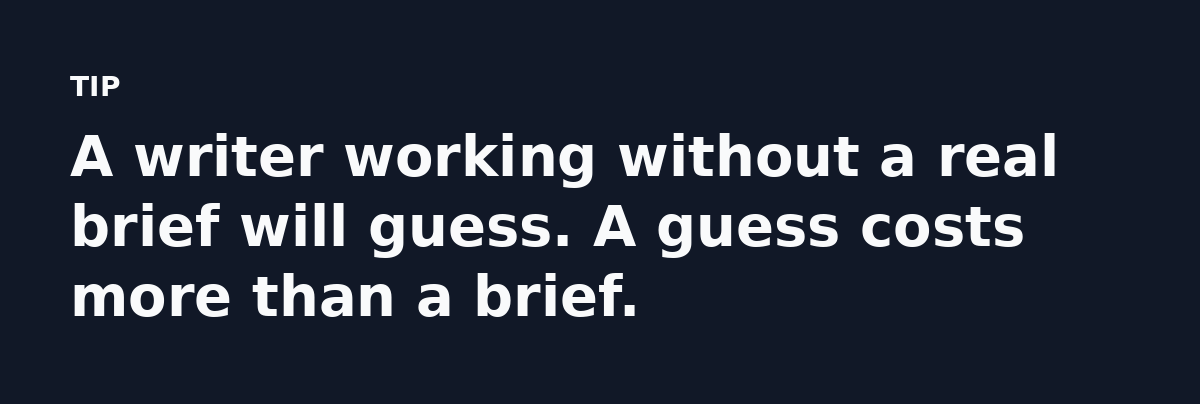
One hour spent writing the brief saves two hours of revision. That math holds whether you hire a freelancer at $0.40 a word or an agency at $2.00 a word.
What a Working Brief Actually Contains
Keep it on one page. Six fields beat forty bullets.
- The reader. Not “small business owners.” Name the person. “A practice manager at a 12-chair group practice who has been quoted40 percent higher by a competitor.”
- The moment. Where do they hit this page? A Google search after a demo goes badly, most likely.
- The objection. “My staff will not use another dashboard.” Say it out loud so the draft answers it.
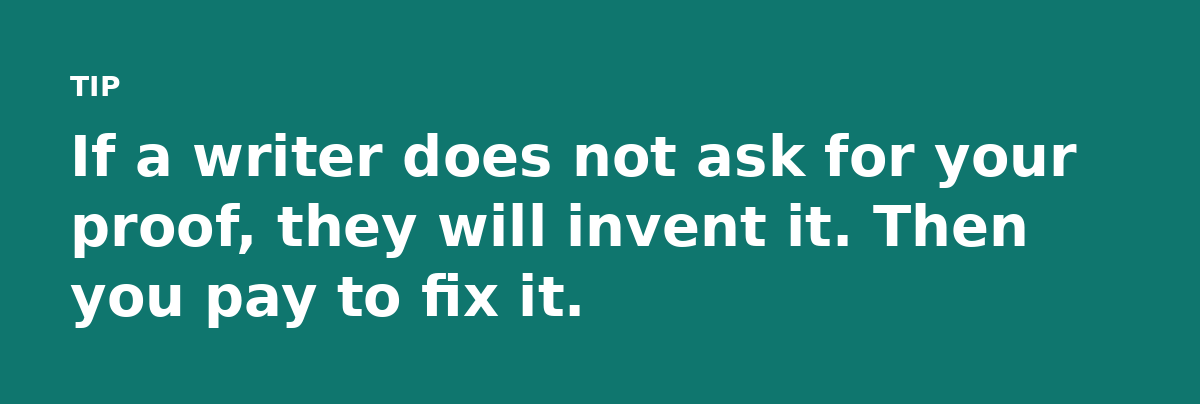
- Proof we have. Support response times, login counts from your own product, named customers who agreed to be quoted.
- What to do next. One action. Booking a call, downloading a checklist. Not three.
- Words on the page. Usually 900. Sometimes 2,400 when you are ranking against pages that already own the term.
Notice what is missing. No tone-of-voice manifesto. No list of twenty keywords. No mention of your brand story.
Warning: the keyword list trap
Sending a writer twenty keywords guarantees a draft that reads like twenty keywords. Pick one primary term and two supporting ones. If you want more coverage, write more pages.
What It Should Cost, Really
Market rates in2026 cluster in predictable bands. Lower rates are usually per word. Higher rates are per project or per day.
- Fresher freelancers. $0.15 to $0.40 a word. Fine for top-of-funnel listicles and definitional posts. Rarely strong on research.
- Specialist writers with a track record. $0.60 to $1.20 a word. This is where most owners should sit.
- Subject matter experts. $1.50 to $3.00 a word. Worth it for anything your buyers will check.
- Agencies with strategy attached. $2.00 a word and up or $3,500 to $8,000 a month for a fixed volume.
Here is the number most owners miss. A $0.25 a word writer finishing eight posts a month costs roughly $700 for7,000 words. A $900 a month retainer sounds steep until you divide it by output. The retainer buys a process. Per-word buys a transaction.
That is the actual choice in front of you.
The Three Questions That Sort Writers Fast
You do not need a test project. Ask these and listen to how long the answers take.
- “Show me a page you wrote for a business in my industry that ranks.”
- “What did your last client change in your draft before publishing?”
- “What information do you need from me before you can start?”
Question three is the tell. A writer who asks for customer stories, internal data and the real objection list costs you more upfront and less overall. A writer who says they can start Monday with what you have is telling you the revision is coming out of your budget.
The Handoff That Kills Projects
Most outsourced content dies in the last week of the month. Three fixes do most of the work.
Set a reply deadline
48 hours, then they ship with what they have. Without that, drafts sit for a week and the calendar collapses.
Comment on the brief, not the draft
Twenty-five words in the brief saves a round of redlining on 900 words of copy. Redlines cost more than briefs.
Pay per approved piece
Hold the last 20 percent until the piece is live and indexed. Writers who vanish after the first draft rarely do it twice.
When Outsourcing Genuinely Loses
Some things should stay inside the building. Your pricing page, because nobody else knows your numbers. Your onboarding docs, since support reads them daily. Your founder’s opinion pieces, because the whole point is that a person said it.
Everything else on your list is a candidate. Most teams that outsource well keep roughly80 percent of content production outside the building and hold the point of view in-house.
Where to Start Tomorrow
Take the last post you published. Write the six-field brief for the next one yourself. Give it to two writers at different rates and compare the drafts side by side.
You will learn more from that one afternoon than from a month of browsing service pages. And you will know within a week whether a done-for-you content writing service is worth the invoice.
Watch the 30 second summary
Video transcript: Most owners blame price when the real problem is the handoff. A topic plus a word count is not a brief, so the writer guesses. Every guess costs you a rewrite. Name the reader, the moment they hit the page, their objection, the proof you have, and one action they should take. One page is enough. An hour here saves two hours of revision. Twenty keywords produce a draft that reads like twenty keywords. Pick one primary term and two supporting ones. Want more coverage? Write more pages. Lower rates run per word and usually come from fresher freelancers. Higher rates run per project or per day. A decent writer lands around 180 to 400 dollars, an expert 600 and up.