
The Short Version
A content writing service prices its words. The contract prices your risk. Get the revision policy and the ownership clause in writing before you pay a deposit. This walkthrough follows one business owner through a real vetting call so you can copy the questions she should have asked first.
Meet Maya. She Wanted Eight Blog Posts.
Maya runs a twelve-person equipment repair company and wanted eight blog posts to pull in search traffic from local contractors. Two agencies sent quotes the same afternoon.
The first quote read $0.14 per word, which works out to $1,344 for eight posts at 1,200 words each. Maya reached for her card.
Then she compared the fine print: the second agency charged the same per-word rate under different rules. That difference added $836 by the end of the project.
Clause One: What Counts as a Revision
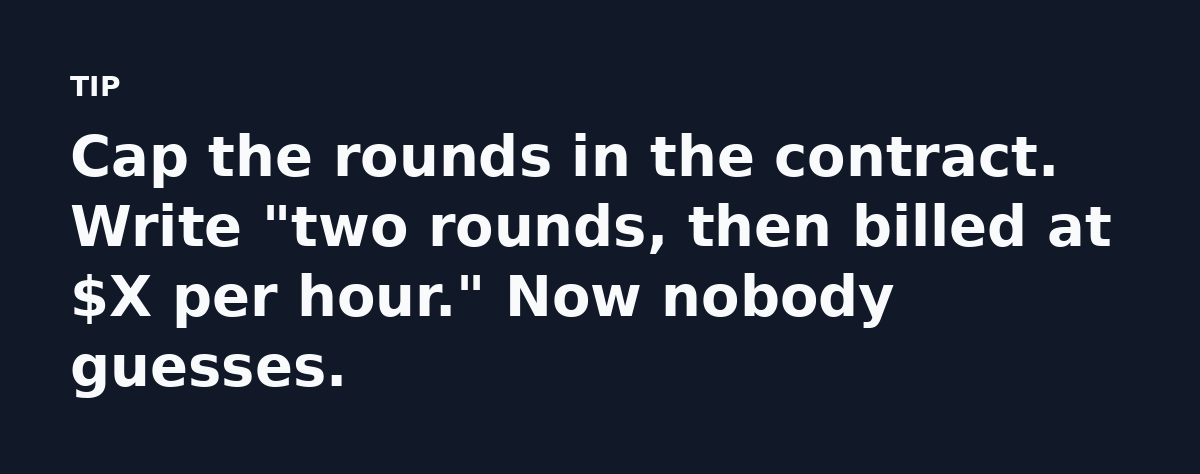
Maya’s first agency promised “unlimited revisions,” as most do, but the terms attached a definition: one round of changes to structure, one round of edits to wording. After that, edits billed at $75 an hour.
Maya sent three rounds. The first two were free; the third landed as a $225 line item she never approved.
Ask the writer to define a revision in one sentence, then ask what triggers a new draft, since a new draft means different scope and a new fee.
Clause Two: Who Owns the Words
Maya paid for the posts and assumed she owned them. The standard contract kept a portfolio clause that let the agency reuse her content in its own marketing and resell the rights later.
Picture a competitor licensing the exact post that ranks for your main keyword.
Ask for full transfer of rights in writing, with no residual license or resale window. Get it in the signature block rather than a verbal yes on a call.
Clause Three: SEO Was Priced Separately
The $1,344 covered writing only; keyword research sat outside the scope. Maya’s agency quoted $300 to run it.
Worse, nobody owned the outcome. If the posts never ranked, the reply was “we wrote what you asked for.”
Ask who picks the keywords and who is accountable when the page does not move. If the answer names no person, expect no traffic.
Clause Four: The Brief Changed Once. The Invoice Changed Twice.
Halfway through, Maya added a product launch to two posts, which feels small but is new work in scope terms.
The agency billed a $150 change order, which was fair, then billed another $150 to redo keyword mapping she never requested. That one she fought.
Ask for a written change-order rule: any new request needs a fixed price before work starts.
Clause Five: When Does the Clock Start?
“48-hour turnaround” sounds simple, but it is not: did the clock start when Maya paid or when she approved the outline?
Hers started at approval. She approved nothing for nine days then blamed the delay on the writer, who blamed the brief. The posts arrived late and everyone lost.
Ask them to write the trigger sentence. “Turnaround begins when the approved brief is received.” Now the clock is honest.
Where the $836 Came From
Add it up.
- Third revision round: $225
- Extra keyword research: $300
- Two change orders: $250
- Late formatting fee: $61
The original invoice was $1,344 and the final was $2,180.
Here is the running math. Real cost per word equals the quote plus every extra, divided by delivered words. Maya’s quote ran $0.14 a word. After extras it ran $0.23.
Your 20-Minute Check Before You Sign a Content Writing Service
Run these before you pay anyone.
- Write down the revision cap and the hourly rate that follows it.
- Get full ownership transfer inside the signature block.
- Name the person accountable for keyword results.
- Set a fixed price for any change order before work starts.
If a vendor stalls on any single one, pause.
The One Question Worth Memorizing
Ask this: “Walk me through everything that costs extra.” A straight answer lists the extras in one breath; a vague answer means you find them later, on the invoice.
Maya now asks it on every call. Her last project came in $40 under the quote because the extras were priced up front.
Print the questions and keep them next to your laptop.
Read the full guide: Done for You Content Writing Service: 6 Myths That Cost Business Owners Money