Most cheap SEO content writing fails for one boring reason: the order was vague. A writer got a topic, guessed at intent and shipped something generic. You can fix that before you ever open a marketplace.
Key Takeaway
Affordable SEO content writing comes down to two inputs on your side: a one page brief and a paid test before you commit. Instruction quality decides the outcome.
Step 1: Name the Job the Article Has to Do
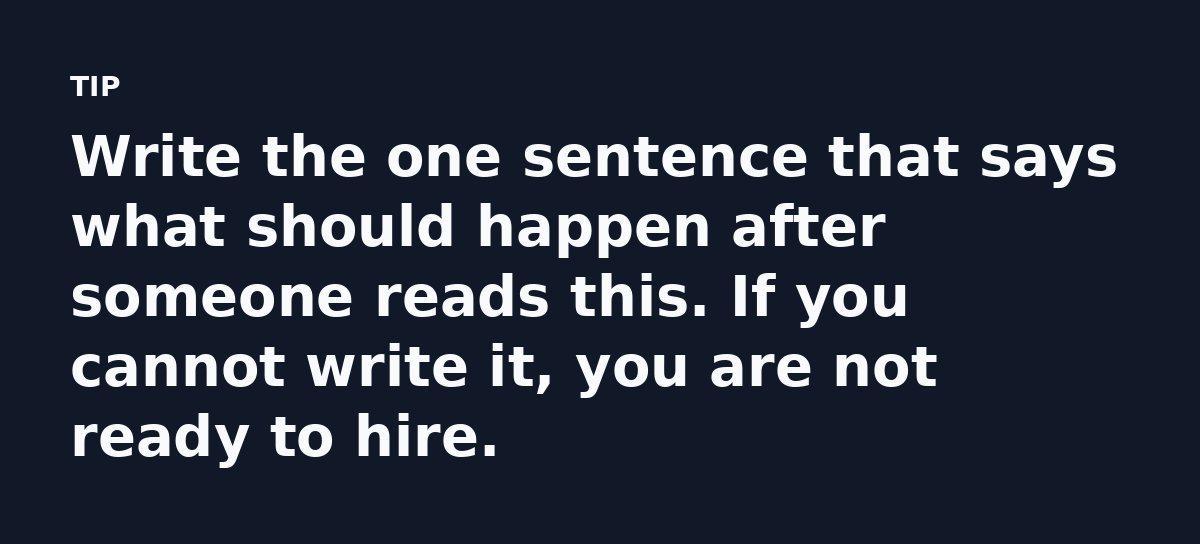
Before you price anything, write one sentence describing what the piece must accomplish. “Get a qualified buyer onto the demo request form” is a job. “Write about CRM software” is not.
Next, pin the search intent. A post that answers how to do something earns links and builds authority with practitioners. A post that compares tools or pricing earns trial sign ups. Different intent and a different structure.
Here is the test. If your target query is content writing rates per word, the searcher is close to buying and they want numbers fast. Put a comparison table in the first third of the page. If the query is how to write a content brief, the searcher wants the template. Hand it over early.
Step 2: Write the Brief, Not the Topic
A topic is two words. A brief is a page. Here is what belongs in the one you send:
- The single reader question the article answers, written as a full sentence
- One focus keyword plus the handful of related terms that must appear naturally
- An outline in your wording, with the point you want under each heading
- Two or three competitor pages the writer should beat, with a note on where they fall short
- Target length and the format the draft needs (how-to steps, comparison table)
- Two examples of writing that sound like your brand, linked or pasted
A writer who receives five headings in order will return five sections in order, roughly on length, with research filling the gaps.
Warning
Briefs that say “write something engaging and comprehensive” produce 1,800 words of padding. You will pay for every one of them and then cut them yourself.
Step 3: Pick a Number You Can Defend
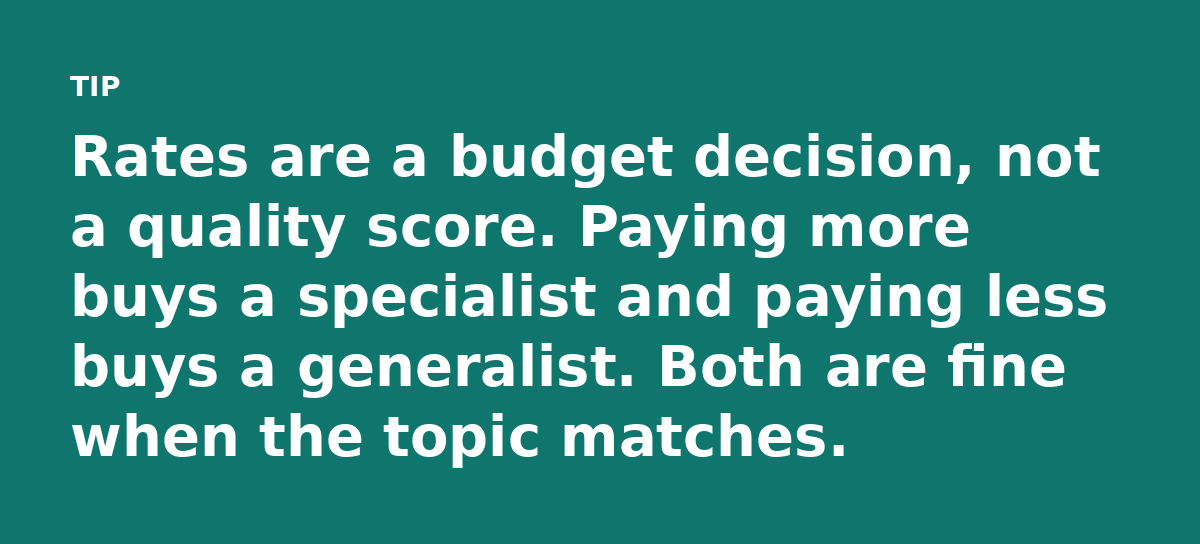
Freelance rates cluster into bands. Commodity blog posts run about $0.02 to $0.08 a word. Experienced writers with a niche specialty sit around $0.10 to $0.25.
Run the math on a 1,200 word article: $0.08 a word comes to $96 and $0.50 a word comes to $600. Six articles a month at the low band lands near $580, while an agency retainer of $4,000 to $15,000 a month buys the same six pieces plus account management you did not ask for.
Decide which band your topic deserves. A personal finance blog and a piece about HIPAA compliant software do not belong in the same line item.
Step 4: Look Where the Filter Already Ran
Skip the open bidding pits. The lowest bid usually comes from someone with no history and no samples and you will spend your own time proving it.
Better sources, roughly in order of how fast they work:
- Marketplace profiles that display lifetime earnings and a repeat client count
- LinkedIn and niche forums where hiring threads run constantly
- Referrals from other operators, who have already watched the work arrive on time
- Contractors you have used before and who already know your style
Ask every candidate for three live URLs they wrote that currently rank. Two things get revealed fast: whether they can show receipts and whether they understand what an owner actually wants to read.
Step 5: Buy a Test, Do Not Ask for a Free Sample
Free samples get recycled. Every applicant writes your opening section from your public brief, so you receive four versions of the same paragraph.
Instead, pay one candidate for 300 to 500 words with a 48 hour deadline. Keep the money even when the test is mediocre, because you now own a sample and a working relationship.
This caps your risk: a 20 article batch takes six weeks to go wrong and a single paid section takes two days.
Step 6: Score the Test on Four Things
- Did they land the target length without stretching every section to fill it
- Does each heading state something a reader wants to keep reading
- Did your examples and outline show up in the draft
- Did they flag a factual problem instead of inventing a statistic
That fourth item separates writers from decorators. A writer who emails back saying “your number here looks wrong, here is the source” is worth more than one who silently guesses.
Zero edits is worth checking. Ask why nothing needed changing.
Step 7: Agree the Edit Loop Before Money Moves
Put revision terms in writing. Two rounds of edits are standard. After that you pay an hourly rate and you decide whether the work is worth it.
Also agree what counts as a revision. Questions and fact corrections are free, but rewriting a section you already approved is new work. Writers respond well to this because it protects their time too.
Do this now
Open one recent draft you published and count how many rounds of editing it took. Write the count down before you hire anyone.
Step 8: Turn One Hire Into a System
Once a writer passes the test, ask for a monthly retainer at a small discount, maybe 10 to 15 percent below their per word rate. Six pieces a month keeps the writer learning your business.
Keep two shared files. One is a style guide covering voice and banned phrasing. The other is a blank brief template with the fields already filled in as questions. Onboarding the next writer then takes an afternoon instead of a month.
Track four numbers per month:
- Total spend divided by published words
- Hours you spend turning a topic into a brief
- Average revision rounds per draft
- Pages that reach page one within 90 days
If revisions climb while rankings stall, the problem sits in the brief. If revisions stay low and rankings stall, the problem sits in the topic choice.
What To Do This Week
Pick your next article topic and write the brief. Send the same brief to four candidates with a rate attached.
Buy one paid test and score it on the four points above. Whatever you learn this week will beat six months of guessing which writer to trust.
Watch the 30 second summary
Video transcript: Before you price anything, write one sentence naming what the article must accomplish. Getting a qualified buyer onto your demo form is a job. Writing about CRM software is not. A topic is two words. A brief is a page: one reader question, a focus keyword with related terms, your outline, two or three competitors to beat, target length and format, plus two samples of your brand voice. Commodity blog posts run two to eight cents a word. Niche specialists run ten to twenty five. On a 1,200 word article that is $96 versus $600. Know which band you are buying before you search. Run one paid sample before you commit to a full order. The test shows whether the writer follows instructions, hits the intent you defined, and cuts the padding. Cheap writers fail on vague briefs, not on price.
Need this run for you? See the writing service.