Done-for-you content writing sounds expensive when you first see the fee. Hiring someone looks cheaper only because you picture the salary alone and that picture leaves out most of the bill.
The Salary Is the Smallest Number on the Invoice
Post a writing job and the advert says $65,000. That figure is only where the bill begins.
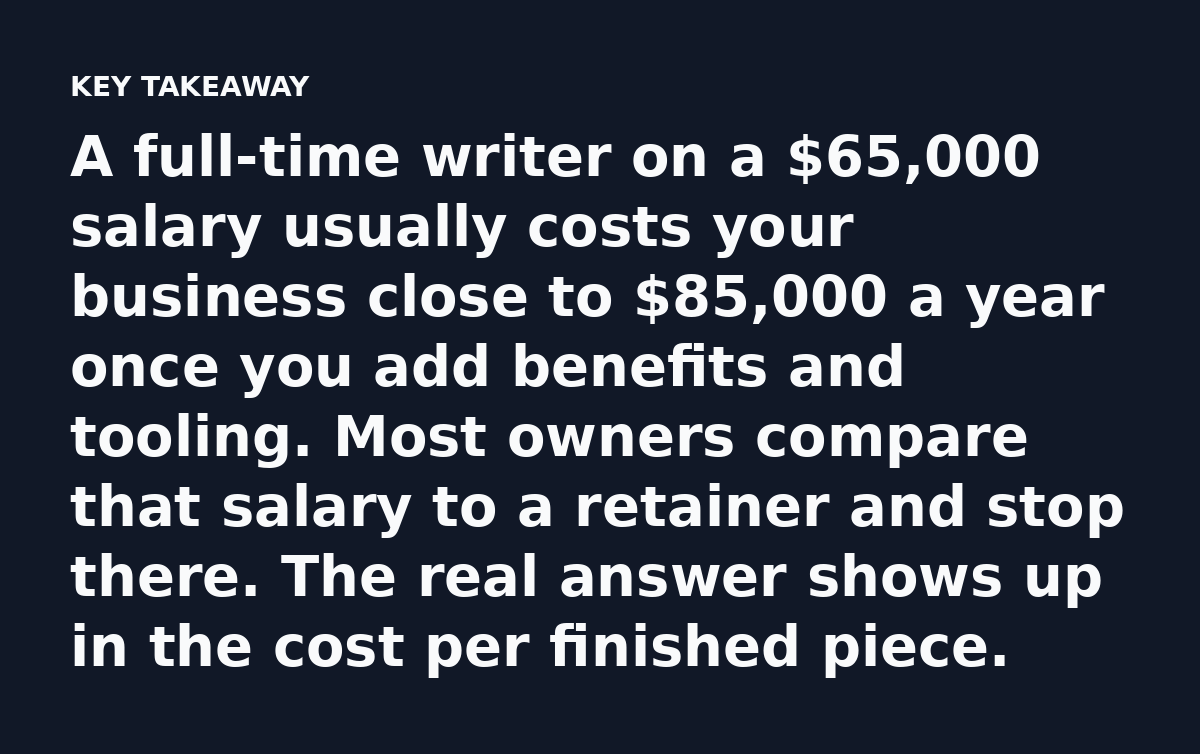
Payroll taxes, health cover, paid leave and retirement contributions add roughly 25%. That pushes a $65,000 salary to about $81,000 before the writer publishes one word.
Then come the tools. A serious writer needs a keyword platform, a grammar checker, stock images and a project tracker. Budget $300 a month, which is $3,600 a year.
Fixed cost now sits near $85,000. Spread across twelve months, that is a little over $7,000 each month.

The Costs That Never Appear on the Offer Letter
Ramp time
A new writer needs months to learn your products and your buyers. Expect slow output for the first quarter. You still pay a full salary during that stretch.
If it takes four months to reach full speed, you have spent roughly $28,000 on someone still learning what good looks like here.
The management tax
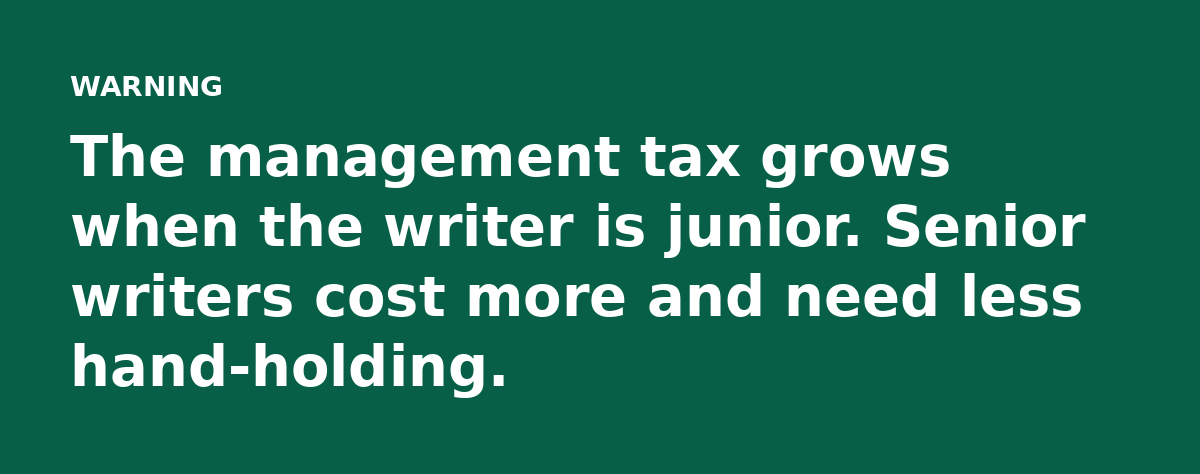
Someone has to brief and edit the work. That person is usually you or a senior marketer.
Say you spend five hours a week on writing management. At a loaded internal rate of $60 an hour, that is $300 a week or $15,600 a year. It is a real cost that stays off the writing budget.
What Done-For-You Content Writing Actually Bills
A done-for-you service works on a flat monthly fee. You agree on a set number of articles, then the provider handles research and writing.
Typical retainers range from $2,000 to $5,000 a month. That covers a defined volume with no overhead. You skip recruitment and idle capacity when work slows down.
If a $3,000 retainer produces ten articles, your cost per piece lands near $300.
Now Calculate Cost Per Finished Piece
Formula: (salary + benefits + tools + management hours x hourly rate + ramp cost) / pieces produced per year = cost per piece.
Run the in-house side with $85,000 in fixed cost. Add $15,600 in management time, then divide by the articles that actually ship. A writer producing eight a month gives you ninety-six a year. That is roughly $1,050 per piece.
Outsourced at $300 per piece saves about $750 on every article. On ninety-six pieces, that is $72,000 a year.
The gap widens when output dips. A slow month still carries the same salary.
The Objection You Are Already Thinking
You may be wondering about quality. Fair. A cheap retainer can hand you thin drafts that need heavy rewriting. That erases the savings.
The fix is a paid test. Give two providers the same brief on a topic you know cold, then read the output with your buyer in mind. Pay for both and you will spot the weak ones quickly at little cost.
Quality is the tie-breaker. Run the test before you sign anything long.
When Going In-House Still Wins
Hiring beats outsourcing in specific cases. Recognize them.
- You publish daily and need someone inside every planning meeting.
- Your field is regulated and complex, so deep product knowledge outweighs speed.
Volume and depth both push toward a hire. Almost nothing else does.

When a Done-For-You Writer Wins
Outsourcing fits most small teams because demand swings: you may need six posts this month and two the next. A retainer absorbs that swing, while a fixed salary cannot.
It also suits owners who are the bottleneck. Hand off the brief and the revision cycle, then reclaim your week for work only you can do.
The One Move to Make This Week
Write down your true in-house cost. Add the salary, the benefits, the tools and the hours you spend managing the work.
Divide that total by the pieces you actually published last year. Then place it next to a flat retainer quote.
The figure tells you which route fits, so get it on paper and let the math decide.
Read the full guide: Done for You Content Writing Service: 6 Myths That Cost Business Owners Money