Executive Summary
B2G lead generation works when you treat every contact as a research subject. Find the agency, the budget line, the buying route and the person who owns the problem before you send a pitch. This guide gives you a four-question test and a pipeline formula you can run this week.
Why Most B2G Lead Generation Lists Fail
Most B2G lead generation lists are unusable from the first day. A conference badge scan or a downloaded attendee file gives you a name and an email. Verify that someone will pay to solve a problem before you add it to your pipeline.
Government purchases follow a budget and a procurement route. Miss one of the four tests and the buyer has no next step.
A qualified government lead has four pieces of evidence: a named owner, a funded problem, a legal buying route and a trigger with a date.
Run the Four-Question Test on Every B2G Lead
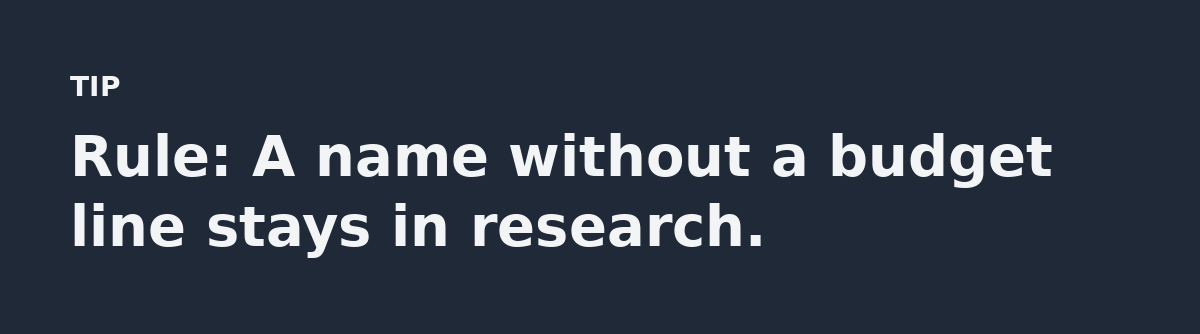
Use this test before a contact enters your CRM: four yes answers keep the contact in your pipeline and one no sends it back to research.
1. Who owns the problem?
Find a program manager or a department director; a procurement officer can explain the rules but rarely owns the business problem.
Use the agency org chart and board packets. If the chart is stale, call the main line and ask for the program office. Write down the person’s title and the date you confirmed it.
2. Is the problem funded?
Find the money in a budget document. State and local budgets list agency line items. Federal budget justifications show programs and requested amounts.
Look for a line item or a grant award and put a dollar figure next to the problem. A general goal to “modernize” gives you nothing to verify.
3. Can this buyer legally buy from you this fiscal year?
Most purchases need a route, so add the route after you know the account. Common paths include an open bid, a cooperative contract, a small purchase card or a set-aside program.
If your product is on a cooperative purchasing contract, many cities and school districts can use that contract and skip their own request for proposal. Check the contract’s scope before you claim that shortcut: a cooperative contract that covers hardware does not cover your software.
4. What forces action now?
Look for a date: a grant that expires, a legacy system that loses vendor support, a compliance rule with a start date or an audit finding with a response deadline.
Without a trigger your contact has a nice-to-have. With one, they have a deadline that creates a meeting.
Build Your B2G Lead Generation List Backwards From the Contract
Start with contracts that already exist: USAspending.gov, a public database, lists federal awards and the agencies that signed them. State procurement sites publish award notices and school board packets list approved purchases.
Search for the agency’s last two contracts in your category; read the scope of work and note the incumbent, the contract value, the start date and the renewal date.
A contract that expires in nine months is a better lead than a cold email list. The budget exists and the buyer has bought before.
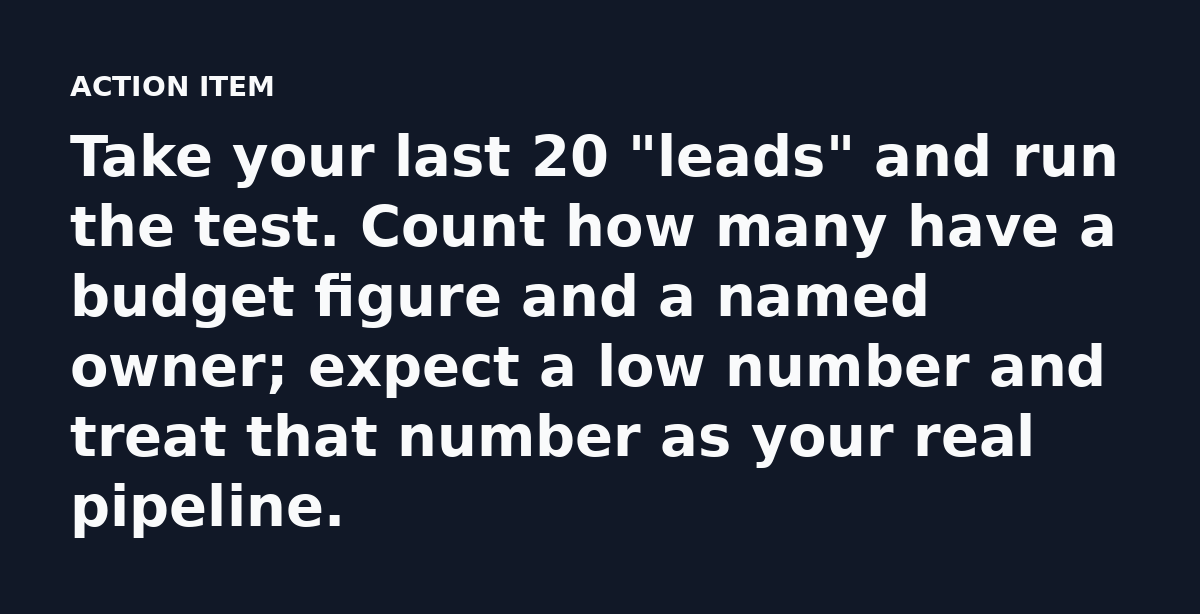
Build a list of 25 accounts inside one agency cluster, such as county health departments in one state. A smaller list with evidence behind every row will outperform a bigger list you cannot verify.
The B2G Lead Generation Math That Kills Bad Lists
B2G lead generation runs on measurable rates. Use this formula:
Meetings = accounts touched x reply rate x meeting rate
Say you touch 150 accounts, 10 percent reply and 40 percent of those replies become meetings, which gives you 6 meetings. If you need 12 meetings you need 300 accounts at the same rates.
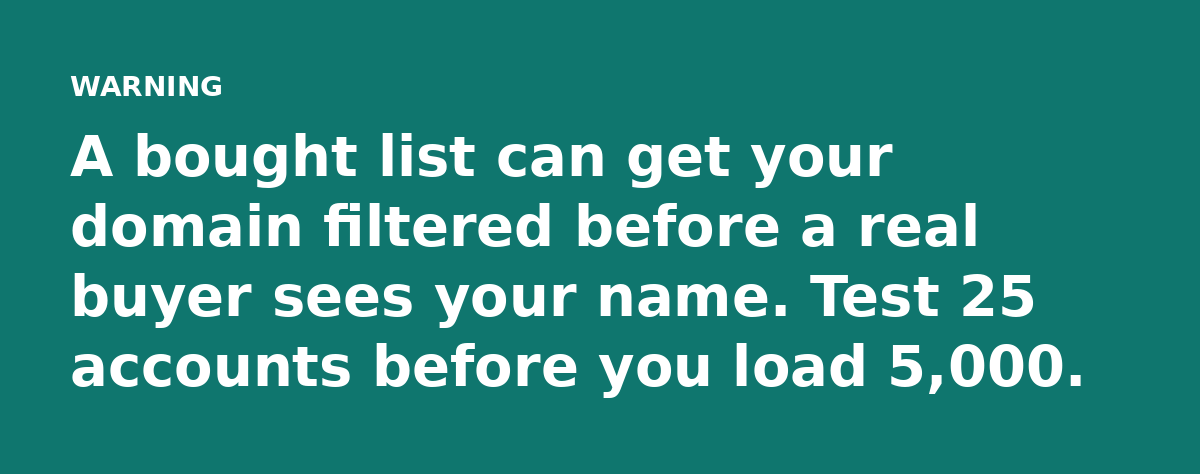
Run the math before you buy any list. A 10,000-name list with a 1 percent reply rate produces 100 replies; if half convert to meetings you get 50 meetings from writing to 10,000 strangers.
Now run the cost: the list price is small, but the real cost is sender reputation and weeks your team spends on bad addresses.
Write to the Program Owner First
The first note should prove you did homework: name the document and its date, then ask one question.
Use a short script:
“You published the [document name] on [date]. The line item for [program] shows $[amount]. I work with agencies on [specific task]. Are you the right person for this or should I speak with [role]?”
That note gives the buyer an easy out and protects you from pitching the wrong person.
Keep the first message under 100 words and do not describe your company history. Buyers care about the problem in front of them.
If the buyer replies with “we already have a vendor” ask when the contract ends. A renewal in 14 months is a reason to keep notes; one in 5 years is a reason to move on.
Use the Fiscal Calendar
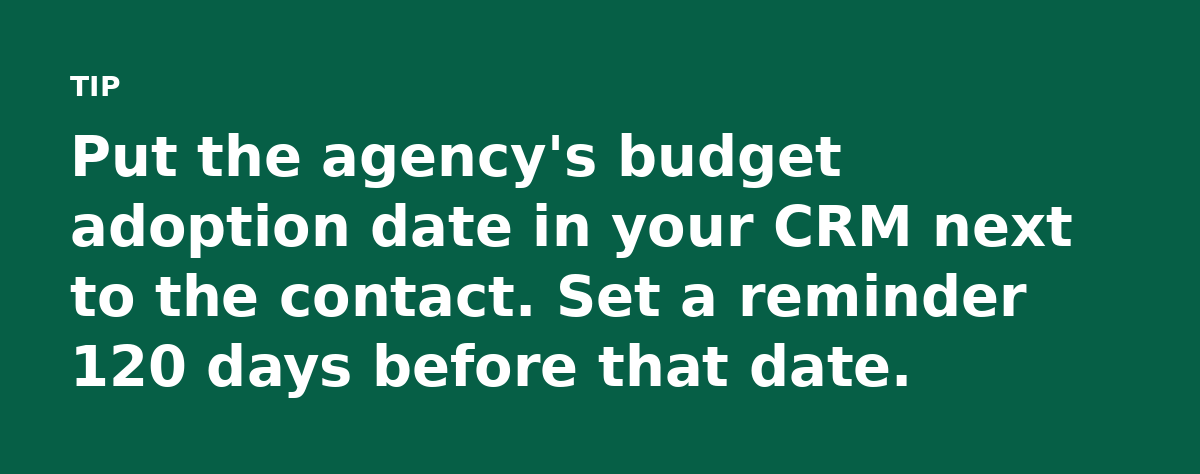
The federal fiscal year ends September 30. Many federal agencies use the last quarter to place orders with remaining funds. Your first touch should land months before that window, when the requirement is still being written.
State and local calendars differ, with some starting July 1 and others October 1. Check the agency’s budget cycle before you plan a campaign.
School districts often approve budgets in spring, so a February message can shape a fall purchase while an August message arrives after the money is committed.
Measure Two Ratios
Track the contact-to-meeting rate and the meeting-to-opportunity rate: the first tells you if the list is right and the second tells you if the offer is right.
If contact-to-meeting is under 5 percent, fix the list. If meeting-to-opportunity is under 20 percent, fix the qualification questions.
Review both ratios every two weeks. A monthly review leaves a bad list in place too long.
Your First 30-Minute B2G Lead Generation Drill
Pick one agency and open its budget page to find one funded program that fits your service. Search USAspending.gov or the state award site for the last contract in that category, then find the program owner in the org chart. Send one note that names the document and the amount.
Do the 30-minute drill once, then do it 24 more times to turn the work into a repeatable pipeline.
Need this run for you? See the outreach service.