Key takeaway
Most B2G lead generation fails because teams buy contacts and treat the list as evidence. A public-sector lead only counts when you can name the budget line, the procurement path, the problem owner and the deadline.
A firm with 1,400 contacts and no forecast
The company reported selling document digitization to county governments. It said its sales team had 1,400 names in the CRM, nine of which had produced a meeting in six months.
The team had no way to tell which names could buy.
Their first instinct was to buy more data and more titles. It would have produced the same result at a higher cost.
What counts as a B2G lead
A B2G lead is a public-sector contact that passes all four tests. Remove any one and you have only a name.
Where the old process broke
The team scored leads on job title and agency size. Both are easy to buy.
Government buying runs on calendars and rules. The federal fiscal year closes on September 30, while many state and local budgets reset on July 1. Money that is not committed before those dates tends to vanish.
Title says who someone is. Money and a legal route decide whether a purchase can happen.
The scorecard that replaced the list
The firm built a four-part test.
- Budget signal. A published budget document or grant award that names the problem.
- Procurement route. A cooperative contract or a published RFP.
- Problem owner. A named official whose job description matches the work.
- Deadline. A date inside 12 months, tied to a fiscal close or a compliance date.
The firm said it applied the budget-signal rule before any outreach.
Where the evidence lives
Budget documents and award notices are public. Federal databases such as USAspending.gov and SAM.gov show contract awards and active solicitations.
The team spent two weeks reading those sources and tagged each agency with its fiscal year end and its active cooperative contracts. That spreadsheet became the most valuable asset in the sales process.
What changed in outreach
Emails opened with a document reference.
In one test, the firm sent a message that cited a county’s five-year capital plan and the exact page where a scanning backlog appeared as a line item. It reported a 14% reply rate on that batch; the old generic batch sat near 1%.
Meetings shifted from product demos to a walkthrough of the county’s award process.
Month four, in numbers
These are the firm’s own results: active contacts fell from 1,400 to 480 and qualified opportunities rose from 9 to 31.
The product stayed the same throughout the test.
Close rate on scored leads was 22%. Close rate on the old list was under 5%.
The objection you are already forming
A common objection is that government sales take too long to test a change like this.
That objection is fair. The firm reported that the first scored cohort took five months to produce a signed contract, while the old process produced almost nothing in 18 months.
A shorter list also cuts cost: less data purchased and fewer hours on dead calls. The forecast becomes defensible to a board.
Where private-sector habits mislead you
Commercial lead scoring rewards speed; government buying rewards patience and paperwork. A prospect who says they love the product means little if the money sits in next year’s budget request.
Referrals work differently: in public agencies, a peer reference from another county often carries more weight than a product demo.
What to do this week
Open your CRM and sort by last activity. Anything with no reply in 90 days and no budget signal goes into a hold folder.
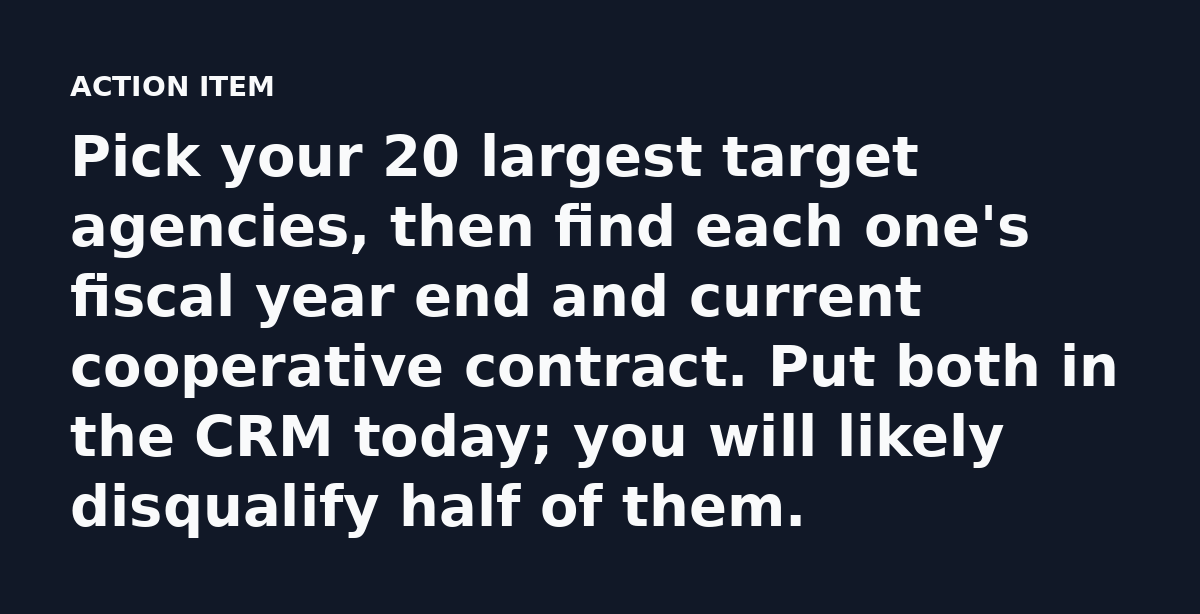
Then build the four columns: budget signal, procurement route, problem owner, deadline. Fill them for your top 20 accounts using public documents.
Send one email that references a real document, then track replies to get your first measure of B2G lead generation in your market.
Start with the documents.
Need this run for you? See the outreach service.