
A strong SEO article can cost $40 or $400. A search engine never sees the invoice. It reads your HTML and how long visitors stay on the page.
Budget writers who understand structure beat pricey writers who do not. This piece covers SEO article writing for people who are new to the work.
Key Takeaway
SEO article writing is a build process. Get the search intent right and structure the page for crawlers. Then edit hard.
Start With the Query, Not the Keyword
Beginners reach for a keyword first. That order is backwards. Start with the exact query someone types. “How to write an invoice” is a query. “Invoice writing” is only a keyword. The query shows you the page to write. The keyword shows you what to call it.
Search intent is the reason behind the query. Search engines sort most queries into four groups: informational, navigational, commercial and transactional. Your page has to live inside the right group or it gets buried.
How a Crawler Reads Your Page
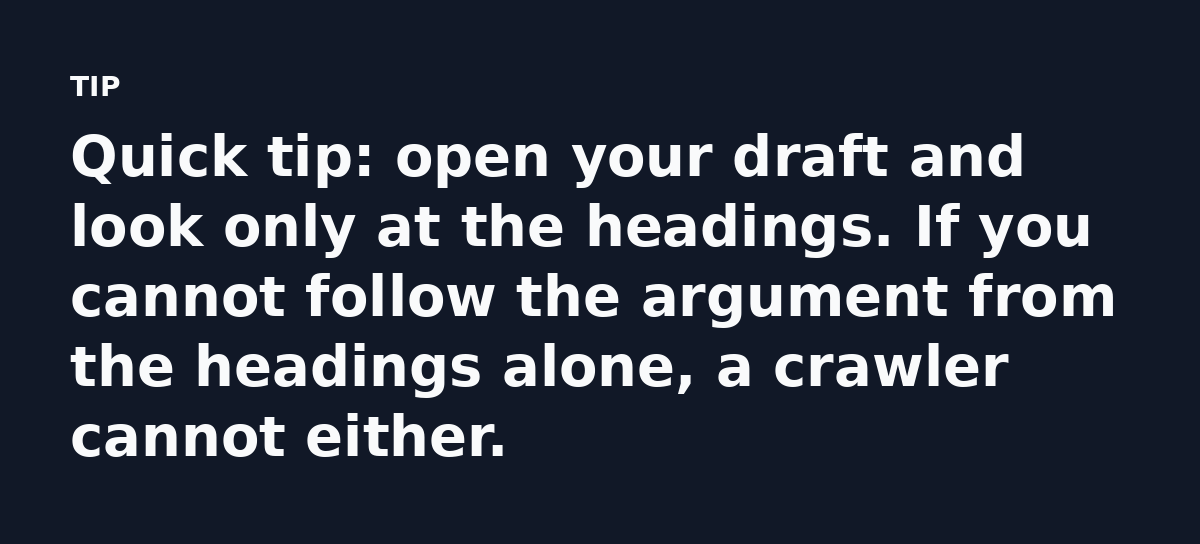
A bot downloads your HTML. It parses the title tag, the headings, the links and the body text. It skips the clever slogan your designer loves. The structure you write is the structure it reads.
Use one H1 per page, set main sections as H2s and push subsections down to H3s. Keep paragraphs short so the page stays easy to scan.
The Intent Match Test
Open the top five results for your target query. Read their headings in order. If four of them are step-by-step guides, a sales page will not rank. If most are product comparisons, a loose blog post will not rank either.
Jot down what the winning page assumes the reader already knows. Match that level. Aim too high and you lose beginners. Aim too low and you bore the people ready to buy.
What Quality Looks Like as a Number
Quality sounds vague but it is not: score every section of your draft. Give a section two points if it answers part of the query and zero if it is filler. Add the points and divide by the number of sections.
Intention score = total points / section count. A score near two means every block earns its place. A score near one means half your article is padding. Cut the zeros then rewrite what is left.
Where the Keyword Goes
Place the target keyword in the title tag, the H1 and the first hundred words. Use it again in at least one H2, then stop counting density. Modern ranking cares about meaning.
Use close variants instead of the same phrase on a loop. “Write an invoice” and “invoice template” carry the same topic. A natural spread reads better and ranks just as well.
Why Cheap Articles Fail
Budget articles usually break on structure. A writer paid per word has one incentive: more words. That pushes them toward padding and vague intros. None of that ranks.
High-priced articles fail the same way when the brief is weak. Money improves the prose but cannot replace a clear outline. If you want a page to rank, you control the outline before the writing starts.
A Brief Any Writer Can Follow
Hand a writer five details and the quality bar jumps: the target query, the reader’s starting knowledge, the headings in order, the word count for each section and the sources you trust.
Add one line at the bottom. “Cut every sentence that does not move the reader toward the answer.” That single rule kills most filler before it lands.
Measure What Readers Do
Rankings follow reader behavior. Pages that hold attention tend to climb over time. Watch two numbers in your analytics: average time on page and scroll depth. If people leave in seconds, the content is not answering the query.
Set a simple target. Aim for readers to pass the halfway point of the page. When they do, your intent match is working.
The One Thing to Fix First
Pick a page you already own. Find its target query. Read the top five results. Rewrite your headings so they match the intent you find there. Then delete every line that does not serve the query.
The core skill is editing to intent. It costs nothing but attention.
Action Items
- Choose one query and confirm its intent before you write.
- Outline the page with H2s before drafting a single line.
- Apply the intention score and cut every zero.
- Move the keyword into the title, H1 and first paragraph.
Start with the query and structure for the crawler. Then cut to the answer. That is the whole method and any business can run it on a small budget.
Watch the 30 second summary
Video transcript: Start with the exact query someone types. The query shows you the page to write. The keyword only shows you what to call it. A bot reads your HTML, not your slogan. Use one H1, set main sections as H2s, and keep paragraphs short so the page stays easy to scan. Read the top five results for your query. If four are step-by-step guides, a sales page will not rank. Match the level they assume. Score every section of your draft. Two points if it answers the query, zero for filler. Divide the total by sections, then cut the zeros.
Need this run for you? See the writing service.