The Short Version
Email still works. Blasting email alone does not. B2B lead generation now runs as a connected system: a clean list and many small touches.
B2B lead generation has a math problem. According to public reports, 73% of buyers say email is their preferred channel. The same research found email-only campaigns pulled 29% fewer leads year over year.
B2B lead generation broke because teams poured more email into a colder, dirtier pipe.
Why B2B lead generation feels harder than it should
Lists decay by about 28% a year, according to public reports. Titles change and mailboxes die. If your contact file is twelve months old, more than a quarter of it is already noise.
Buyers also take longer. Research on prospecting puts the average path at 12 to 15 touches before someone engages. Most teams send one email and move on. Then they blame the copy.
The move most teams make
They buy a bigger list and send more volume. Each move adds noise to a system that needs cleaning.
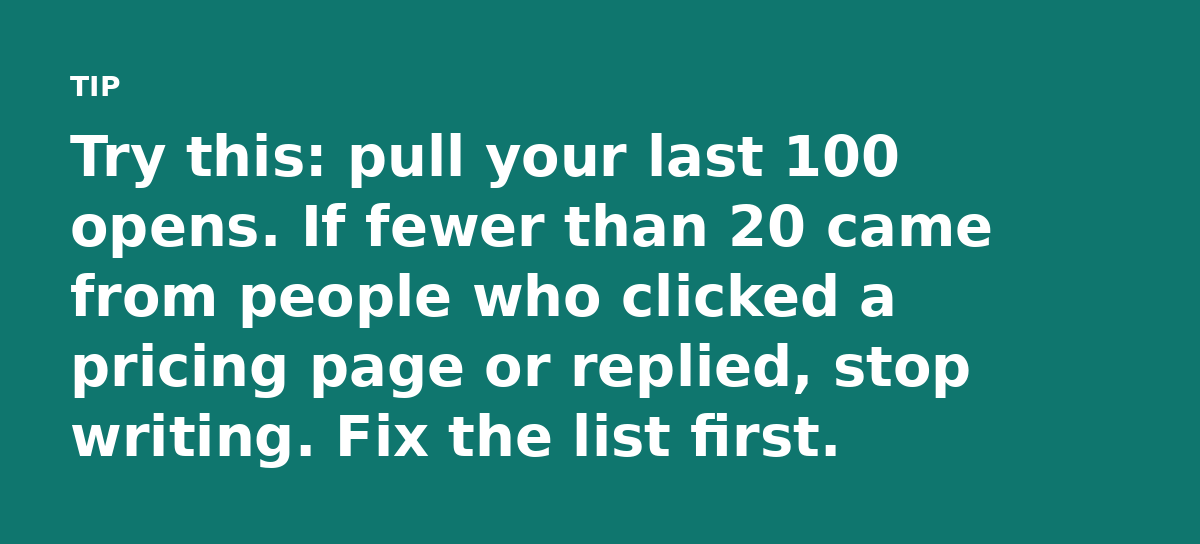
Clean the list before you write the email. Skip the list broker.
A dirty list burns sending reputation and budget at the same time. Bounces tell inbox providers you do not know your audience. That hurts every future send, including the good ones.
Do this instead: pull your last 90 days of sends and sort by segment. Look at bounce rate and reply rate. Cut any segment with a bounce rate above 3%.
Then verify addresses before the next campaign and remove role accounts that never reply. Keep the people who opened twice and clicked once. Those are your real buyers.
One mid-sized software team reportedly cut its list by 41% and saw reply rate climb from 1.8% to 4.6% on the next send. Fewer names. More conversations.
Plan for 12 to 15 touches. One email is not a campaign.
A single send plus a quiet CRM update will not move a modern buyer. The path is longer and it crosses channels. Your job is to be present along that path without being annoying.
The trap is treating each channel as its own island. Email lives in one tool and ads live in another. Nobody sees the full route a buyer walks.
Do this. Map four touches for one segment before you spend a dollar.
- A LinkedIn ad that names the problem in plain words.
- A cold email with one specific observation about their business.
- A retargeting ad aimed at everyone who opened but did not reply.
- A direct call to the warmest 10% of that group.
Four moves for the same buyer. You can run this in a month. Track reply rate and meeting rate. Open rate flatters you. Meetings pay the bills.
Personalize from behavior. Drop the first-name merge field.
“Hi Sarah” is a mail merge with a smile. Buyers spot it in under a second and it makes the rest of your message feel fake.
Real personalization uses what the person did: a pricing page visit or a webinar signup. Those signals tell you what to say next.
Do this: pick one buying signal you already track and write one email that speaks to it. If a prospect read your pricing page twice, send a short note about setup time. Skip the generic demo ask.
Intent data sharpens this. It shows who is already researching the problem you solve. Reach those people with a relevant ad or note while the interest is warm.
Run a content series. Stop publishing one gated PDF a quarter.
Reported research found that 75% of decision-makers say thought leadership pushed them to research a product they had not considered. A series does that better than one gated ebook.
Episodic content builds memory. A four-part series beats four random posts because each piece sets up the next. Buyers come back for the next installment.
Do this: pick one narrow question your buyers argue about. Record four short videos and link each one to the next. Give the final piece a real worksheet.
What to track
Watch return viewers across the series. A person who shows up for part three is warmer than a hundred one-time downloads. Send that person a direct note.
Borrow trust from real experts. Retire the polished pitch.
B2B buyers now listen to creators and niche communities before they take a sales call. A trusted operator in your space carries more weight than a brand page with perfect graphics.
Do this: find two practitioners your buyers already follow. Invite one to a live Q&A and co-write a short guide with the other. Keep the pitch out of it and let their experience carry the message.
This works at any size. A 12-person firm can partner with a respected consultant. A large team can sponsor a community that already has the audience’s ear.
The pattern behind all five
None of these moves is a trick. Each one treats the buyer as a person with a real problem and a short supply of patience. Clean data gets you to the right inbox and multiple touches keep you visible. Useful content earns the next click and real voices close the gap.
B2B lead generation gets easier when you stop chasing volume and start fixing the list and the follow-up.
Your one move this week
Open your CRM and sort contacts by last activity date. Pick the 50 people who opened something in the last 30 days but never got a second touch. Send them one specific, useful note today.
That single action tests the whole idea. Clean data and a follow-up that respects the buyer’s time. If those 50 replies beat your last campaign, you have your new playbook. Run it again next week with the next 50.
Need this run for you? See the outreach service.