Executive Summary
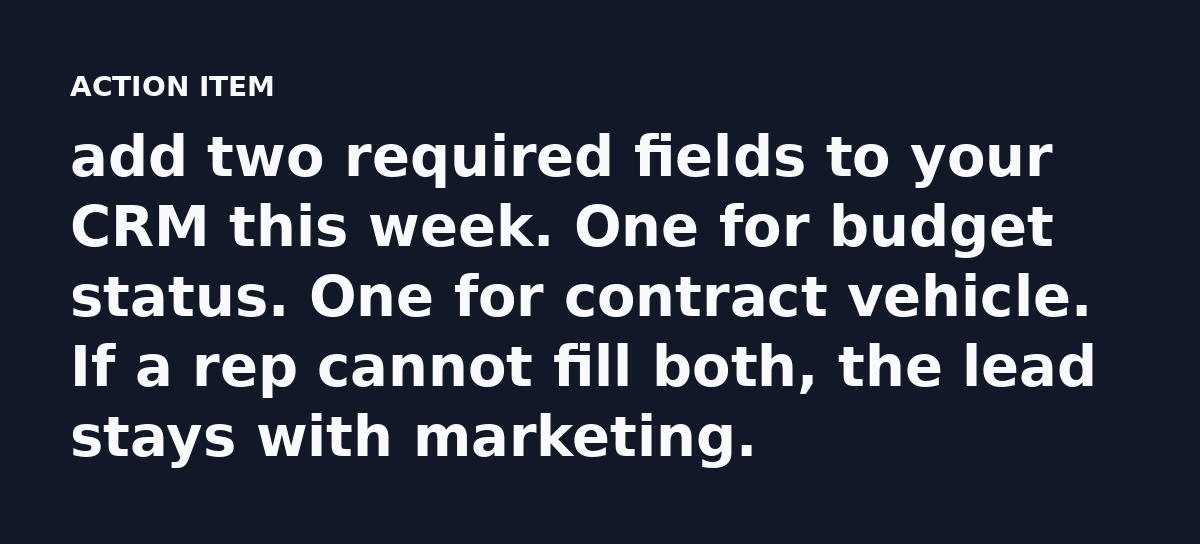
Most B2G lead generation programs measure interest. Public buyers move on money and paperwork. This guide shows how to score leads on procurement readiness, tie each one to a contract vehicle and time outreach to the fiscal calendar. The fix takes two new CRM fields, not a new data vendor.
The Call Went Well. Then Nothing.
A rep books a call with the IT director of a mid-sized county. The conversation is good. The director likes the product and says so.
Then the deal sits for eleven months. No reply. No next step.
Nothing was wrong with the lead. The county had no approved money until the next fiscal year. It also had no contract vehicle that covered the purchase. The rep qualified interest and skipped the two things that decide public deals: funds and mechanism.
A Buyer With No Money
B2G lead generation is the work of finding and qualifying buyers inside government agencies. The buyer is not one person with a credit card. Authority is split across budget officers, procurement staff, legal reviewers and elected officials.
The scale makes this harder. The U.S. Census Bureau counts roughly 90,000 local governments. Each one runs its own procurement rules. Most states start their fiscal year on July 1.
Interest Is Cheap in Public Sales
Commercial teams often import a framework built for private deals. Ask about budget, authority, need and timeline. That works when one buyer controls the money. In government, the person who wants your software rarely controls the funds.
A lead that looks hot in April can be unfundable until the following summer. The contact is real. The buying window is closed.
Score Readiness, Not Enthusiasm
Swap the interest score for a readiness score. Four inputs. Add the points and set a threshold before any lead reaches a rep.
- Budget status: approved money scores 3. A line item in a draft request scores 1. No funding scores 0.
- Procurement path: an active cooperative contract scores 3. A planned RFP scores 2. No route to purchase scores 0.
- Fiscal timing: funds available this quarter scores 3. Next fiscal year scores 1.
- Internal champion: a named staff member who has run a purchase before scores 1. Nobody identified scores 0.
How the Score Works
Readiness score = budget (0-3) + procurement path (0-3) + fiscal timing (0-3) + champion (0-1). The top score is 10.
A score of 7 or higher means the lead can move. Anything below 5 goes to nurture. The middle band gets a research call, not a demo.
Find the Contract Vehicle First
A contract vehicle is the pre-approved path an agency uses to buy. It can be a federal schedule, a state term contract, a cooperative agreement or an agency-specific bid. When a lead has no vehicle, your deal has no door.
NASPO ValuePoint is one example. It lets state and local agencies buy from contracts negotiated across states. A vendor already listed there can close faster because the terms are set. A vendor outside it faces a full RFP and months of waiting.
Ask one question on the first call: how does your agency usually buy this? The answer tells you whether the deal needs a listing or a partner already on contract.
Check the Calendar Before the Demo
Government money moves on a schedule. The federal fiscal year starts October 1. Most states start July 1. Local governments vary, so check each one.
Budget requests get written months before the money appears. If your first email lands in August for a July 1 cycle, you missed this year. You are early for the next one, which still has value.
Use that timing. A message in January about next year’s budget request beats a demo in May that nobody can fund.
Leads That Fail Today
Most leads will fail early. That is normal. The mistake is deleting them.
Tag every low score with a reason and a revisit date. No budget becomes a reminder for the next cycle. A missing vehicle becomes a task for your contracts team.
The champion problem is different. Ask for the right introduction before you ask for a demo.
A nurture list built on fiscal dates converts better than one built on generic drips. A county with no funds in March may have funds in July. Same contact. Different answer.
One Change This Week
Add the readiness score before you add more leads. Volume hides a broken filter. A list of 5,000 names with no budget data is a list of 5,000 future apologies.
Start with the two fields. Score the pipeline you already own. Route the top band to sales now and schedule the rest by fiscal date.
Clean B2G lead generation comes down to knowing which names can actually buy. That filter will do more for your pipeline than any new data source.
Need this run for you? See the outreach service.