Key Takeaway
Most B2G lead generation fails because teams chase names instead of money. A government lead is only real when a funded need, a named owner, a buying route and a deadline line up. Score every account on those four signals before your team sends a single email.
Names Are Inventory
The U.S. has roughly 90,000 state and local governments. Data vendors sell lists with tens of thousands of names.
None of that tells you who has budget.
B2G sales means selling to government agencies. Buyers move through budget cycles and procurement rules. A cold contact can sit in a database for years and never buy. A funded program can move in weeks once the right vendor appears.
Sales teams count contacts while finance counts signed contracts, but the two numbers rarely match.
What Makes a B2G Lead Strong
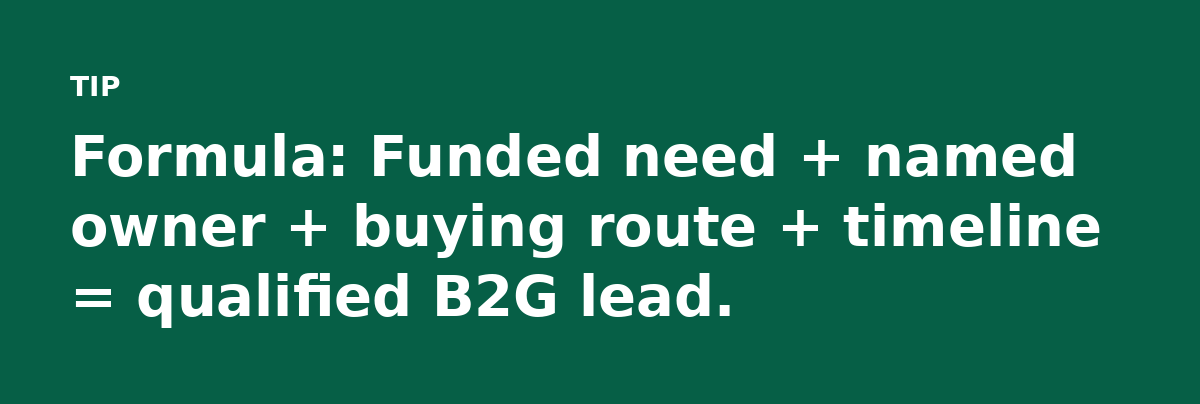
Use four signals.
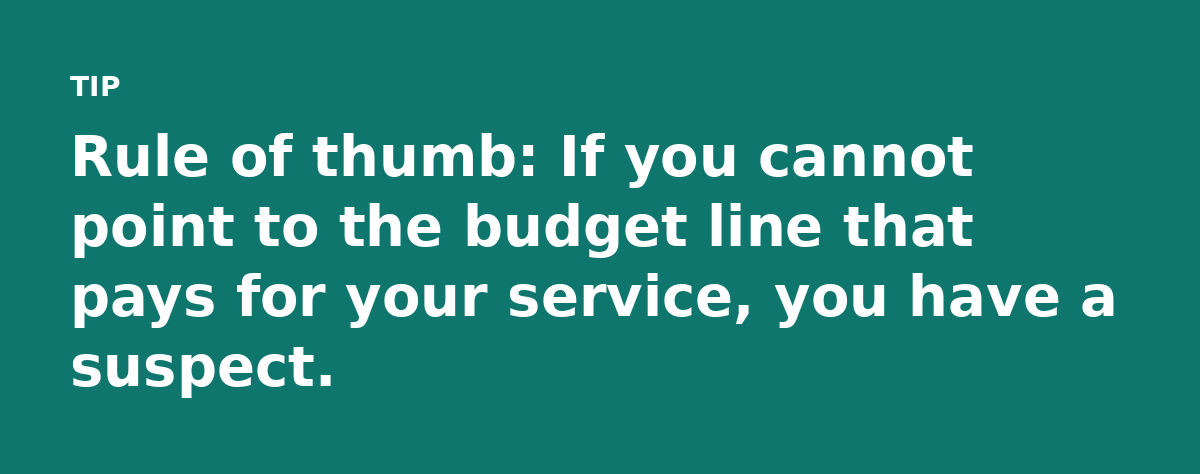
1. Funded need
There is an approved budget line or a capital plan with money attached. The need is written down in a public document. Your category appears in the spending plan.
2. Named owner
You know the person who owns the outcome: a program manager or a department director. The title matters less than the mandate.
3. Buying route
You know how the agency can buy: open RFP, cooperative contract, emergency purchase or sole source with justification. A lead with no route is a research project.
4. Timeline
There is a date attached: budget approval, contract expiration, grant deadline or project kickoff. A lead with no date has no urgency.
The 90-Minute Account Score
Open a spreadsheet. Add four columns: money, owner, route, date. Score each from 0 to 2.
- Money: 2 for a named budget line. 0 for no public money.
- Owner: 2 for a named person with a mandate. 0 for a generic inbox.
- Route: 2 for an active contract vehicle. 0 for no known path.
- Date: 2 for a deadline inside two quarters. 0 for no date.
Total the four columns. A score of 8 means call today. A score of 6 means work this week. A score of 4 means keep in nurture. A score of 0 to 2 means drop.
Score 20 accounts in 90 minutes. The first pass will feel rough, but public evidence does not need to be perfect.
Where Funded Demand Hides
Government money leaves a paper trail. Most vendors never read it.
Adopted budgets
Search the agency’s budget PDF for your category. Look for line items tied to software, consulting, services or equipment. A line item with a dollar amount beats a strategy document every time.
Capital improvement plans
These plans list projects years before construction. Find your product category in the project description. Then find the department that owns it.
Prior awards
Past contracts show what an agency already buys and who sells it. Federal awards are public on USAspending.gov. State and local awards sit on procurement portals and council agendas.
Board packets
School boards and city councils publish meeting packets. Vendor contracts and budget transfers show up there before the RFP. Read the packet and you will see the need before your competitors do.
The Real Objection: Government Buys Slow
Yes, a budget line can take 18 months to become a purchase order. Procurement rules add steps while approval chains add people.
Start early, but qualification still matters.
Slow cycles reward teams that find demand before the RFP. If you show up after the solicitation drops, you are usually too late. The requirements were written with someone else in the room.
Track signals that appear before the money moves: a budget request, a pilot program, a council vote or a grant award. Each one is a reason to start a conversation.
Be the known option when the process starts.
What to Fix This Week
Do these four things this week.
- Delete every contact with no agency and no budget signal.
- Add a source link to every account record. If you cannot link it, you cannot trust it.
- Ask sales to name the buying route for every deal in the forecast.
- Track the number of accounts with a funded need.
Before any outreach, write one sentence: “This agency has money for this problem and this person owns it.” If the sentence sounds weak, the lead is weak.
The One Thing to Do Next
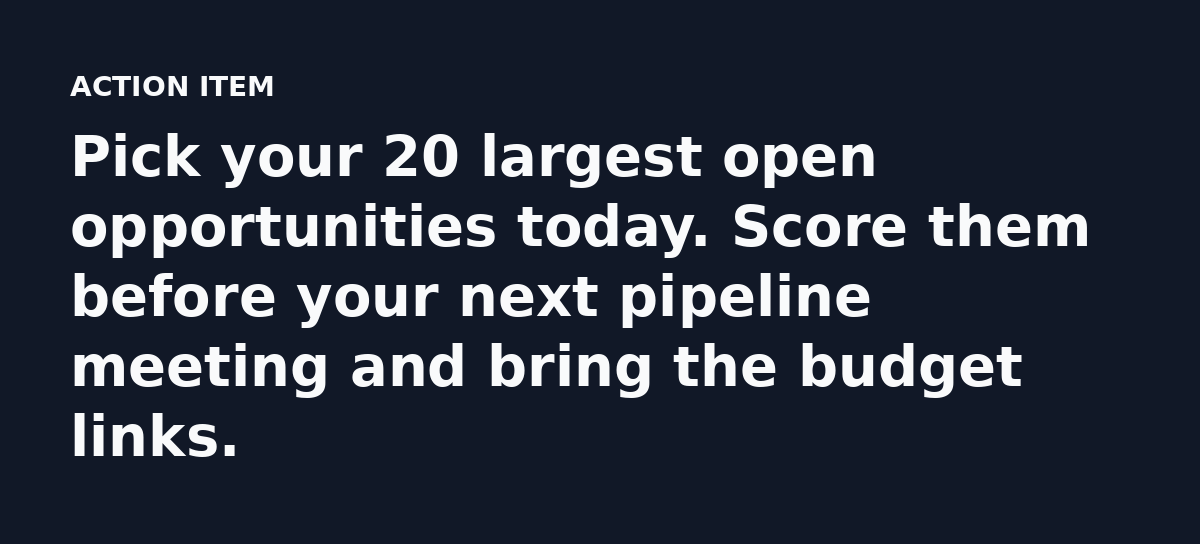
Choose one account you believe in and open its adopted budget. Find the line item that pays for your category. If the line is missing, the account is not ready.
B2G lead generation gets easier when you stop guessing. Score the evidence and pitch.
Need this run for you? See the outreach service.