
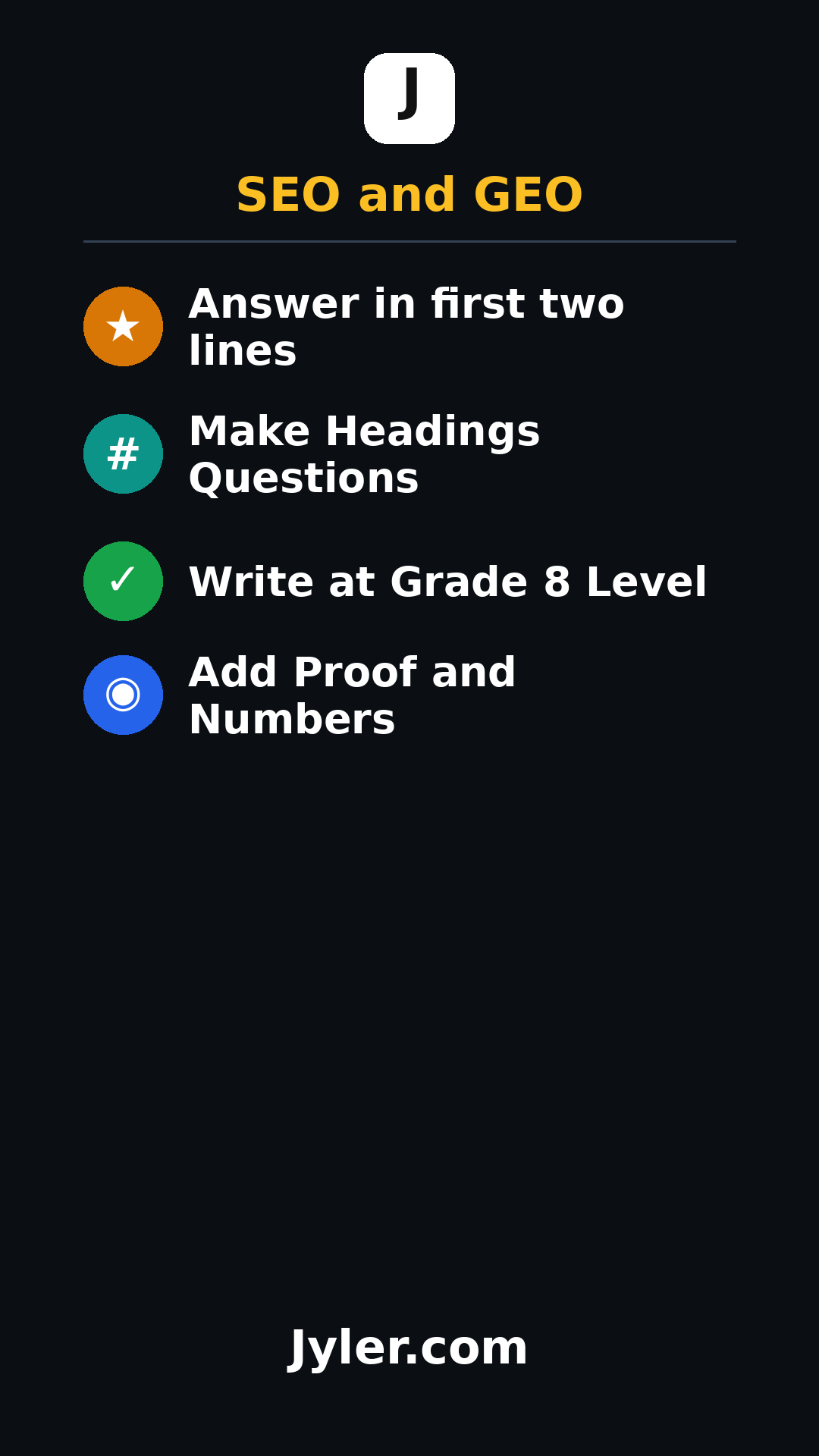
The Short Version
Search engines rank links. AI assistants quote sentences. One page can win both and it takes a single editing pass to get there. This guide walks you through SEO and GEO step by step.
Why SEO and GEO Share the Same Page
A Google result is a doorway. A ChatGPT answer is the room. When someone asks an assistant how to scrape product data at scale, the model either names a source or answers from memory. Your page only gets credit if it is easy to quote.
That field is called GEO, short for generative engine optimization. According to a published paper on the topic, adding citations and statistics to a page raised its visibility in AI-generated answers by up to 40%. No redesign and no new domain. Just tighter editing.
The writing job changed. You now write for a crawler that ranks links and a model that decides whether to mention you in a sentence.
Step 1: Put the Answer in the First Two Lines
Models read the top of the page first. If the useful answer sits under three paragraphs of background, the model skips it.
Open with the payoff. A line such as “Manual invoice processing costs roughly $10 per document” tells the reader and the machine what the page covers in one breath.
Then backfill the context. Put the story after the answer.
Step 2: Turn Headings into Questions
People type questions into search bars and chat boxes. They rarely type keywords. “How do I reduce data entry errors” is a query. A noun phrase like “data entry optimization” only speaks to a search tool.
Make your main heading match the question. Then answer it in fewer than 60 words directly beneath.
Look at the heading that opens this section. It is a plain question.
Step 3: Write at a Grade 8 Reading Level
AI answers get read aloud by voice assistants. Long clauses break that flow.
Swap “utilize” for “use.” Swap “in order to” for “to.” If a sentence needs three commas to survive, split it into two sentences.
Run your draft through a free readability checker. Aim for a grade 8 score on the paragraphs a buyer will actually read.
Step 4: Feed the Model Proof
Assistants trust numbers and named sources. Add at least one of these to every major section:
- A statistic with a named source
- A short direct quote from a real person
- A worked example with actual figures
- A small table or a one-line formula
One hard number beats a paragraph of praise every time. If you cannot find a number, use a named customer and a real outcome.
Step 5: Run the Ten Minute Editing Pass
You do not need the original writer to fix a page. An editor can rebuild it from the source notes alone.
- Read the first 60 words. If no answer appears, move the answer up.
- Delete every sentence that could sit on a competitor’s site unchanged.
- Replace each vague claim with one number or one name.
- Check that every heading matches a question a real person types.
- Read the page out loud. Any sentence you stumble on gets a rewrite.
Step 6: Refresh Before the Page Fades
Models retrain and crawlers recrawl. Pick your money pages. Once a quarter, add one new statistic and swap in a fresher example. Update any fact that has moved. This keeps the page citable without a full rewrite.

Where Most Writers Trip
They chase keyword volume and ignore the question behind it. They write for a ranking position and never for a quote.
A focused page on one question beats a broad page on a vague topic in AI answers.
Your Next Move
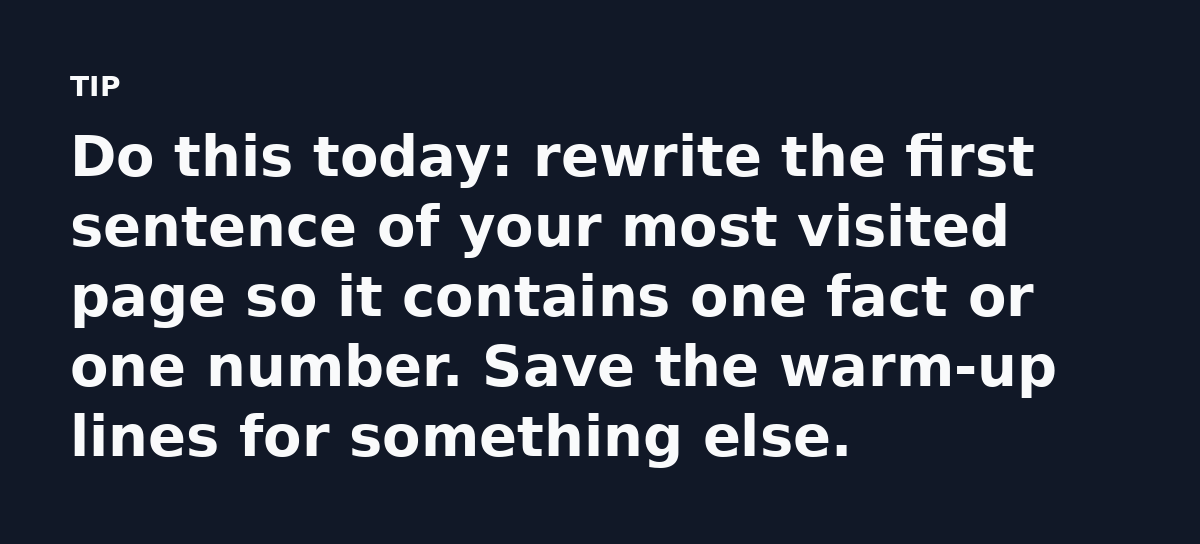
Open your best-performing page and rewrite its first sentence so it states one concrete fact. Then turn the main heading into the exact question a customer would type.
That is the whole first pass. It sets up the page for search engines and AI assistants. Do that one page today, then run the same pass on the rest.
Watch the 30 second summary
Video transcript: Models read the top first. Open with the payoff, like a hard number. Then add the background after. Put the story after the answer. People type questions, not keywords. Make your main heading match the question. Then answer it directly beneath in under sixty words. AI answers get read aloud. Long clauses break the flow. Swap utilize for use and in order to for to. Split comma-heavy sentences in two. Aim for grade eight. Assistants trust numbers and named sources. Add a statistic, a direct quote, or a worked example to every major section. One hard number beats a paragraph of praise.
Need this run for you? See the writing service.