
Executive Summary
Two billing models get used for content writing: a monthly retainer and a fixed per-project fee. The retainer feels safe. The per-project fee feels risky. The price tag on the invoice rarely shows which one is draining your wallet. This primer hands you a simple way to compare them so you can pick the model that fits how you actually publish.
First, What Each Model Even Means
A retainer is a set monthly fee for a set amount of work. You pay whether you use it all or not. Say you agree on four articles a month for a flat $2,000. That works out to $500 per article, but only if all four get delivered and approved.
Per-project pricing is a single fee for a single deliverable. One article. One landing page. You buy it when you need it and you pay after the scope is agreed.
Both are legitimate. The trap hides in the gaps between what you pay for and what you receive.
The Quiet Cost of Unused Retainer Hours
Most retainers carry a use-it-or-lose-it clause. Skip a busy month and that content does not roll over. The fee still leaves your account.
Run the math on a real case. A $2,000 retainer for four articles. One month your product team goes heads down and you approve only two. You paid $1,000 for work you never got. Do that twice in a year and the effective price of each delivered article climbs from $500 to roughly $750.
Do this before you sign any retainer
- Look at how many articles you published in the last six months. Count actual output.
- Ask what happens to unused work. Rollover, credit or gone?
If your publishing is steady and predictable, a retainer can lower your per-piece rate. If it swings up and down, you are paying for calm that never arrives.
When Per-Project Pricing Bites Back
Per-project looks lean. You only pay for what ships. The problem shows up in coordination and speed.
Every new project restarts a small negotiation. Scope, revisions, deadline, invoice. That back and forth eats your week. Many writers also charge a repeat-client discount or offer lower rates inside a retainer, so the per-project route can run 10 to 20 percent higher per piece.
Then there is turnaround. A writer juggling projects may slot you behind standing clients. Your launch date does not move, but your content does.
A Simple Way to Compare the Two
Forget the headline fee. Find the real cost per published piece.
Effective cost = total paid in a year ÷ pieces actually published and approved.
Track that number for both models over a few months. The cheaper-looking invoice often loses once you count the idle months and the admin time.
What to put in the numbers
- Total spend, including any setup or rush fees.
- Deliverables that passed review rather than drafts.
- Hours you spent managing briefs and edits.
- Missed deadlines that pushed a campaign.
Match the Model to Your Publishing Rhythm
The right choice follows your calendar more than the writer’s sales pitch.
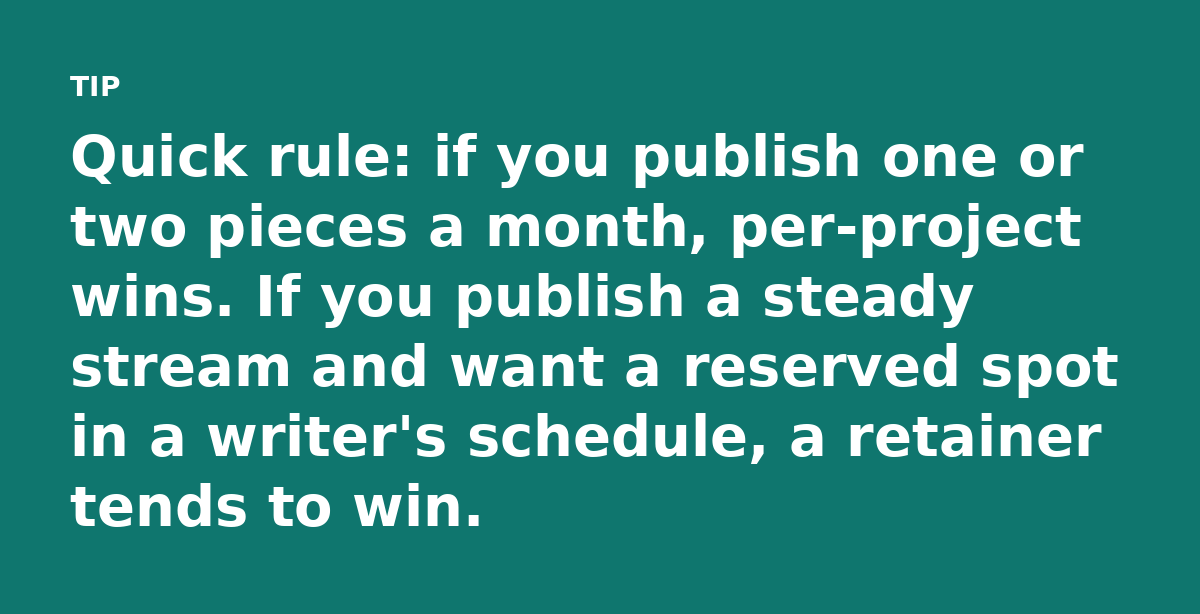
Steady publisher with a fixed content plan? A monthly retainer buys priority and a lower per-piece rate.
Sporadic publisher or one with shifting priorities? Per-project keeps you flexible and stops wasted spend in quiet months. You trade some speed for control.
Some teams split the difference. They keep a light retainer for recurring blog posts and buy bigger pieces, like case studies or landing pages, per project. This covers the predictable work while leaving room for the spikes.
Questions to ask any writer
- What is the per-piece rate inside the retainer versus outside it?
- Do unused hours roll over and for how long?
- How many revision rounds are included before extra charges start?
- What is the exit notice and are there penalties?
Get these answers in writing. Verbal promises fall apart when a deadline slips.
Watch for the Real Warning Signs
A retainer is inflating your costs when your delivered count sits far below your allowance month after month. That is a subscription you are not using.
Per-project is hurting you when the admin overhead or rushed fees climb past the value of the content itself. If every piece costs you three email threads and two follow-ups, the cheap rate is a myth.
Your Next Move
Open your last six months of invoices and count the pieces that actually shipped. Divide total spend by that count. That single figure tells you more than any rate sheet.
If the retainer rate comes out lower and your output is steady, keep the retainer. If per-project comes out lower or your output swings, drop the retainer and buy work as you need it. Then set a simple rule: review the model every quarter against real published output.
Then hold the model to one test: did the work ship and did the price make sense for what landed?
Read the full guide: Content Writing Service Pricing: What the Invoice Never Shows