What does a content brief actually do?
It moves the thinking out of your head and into the writer’s.
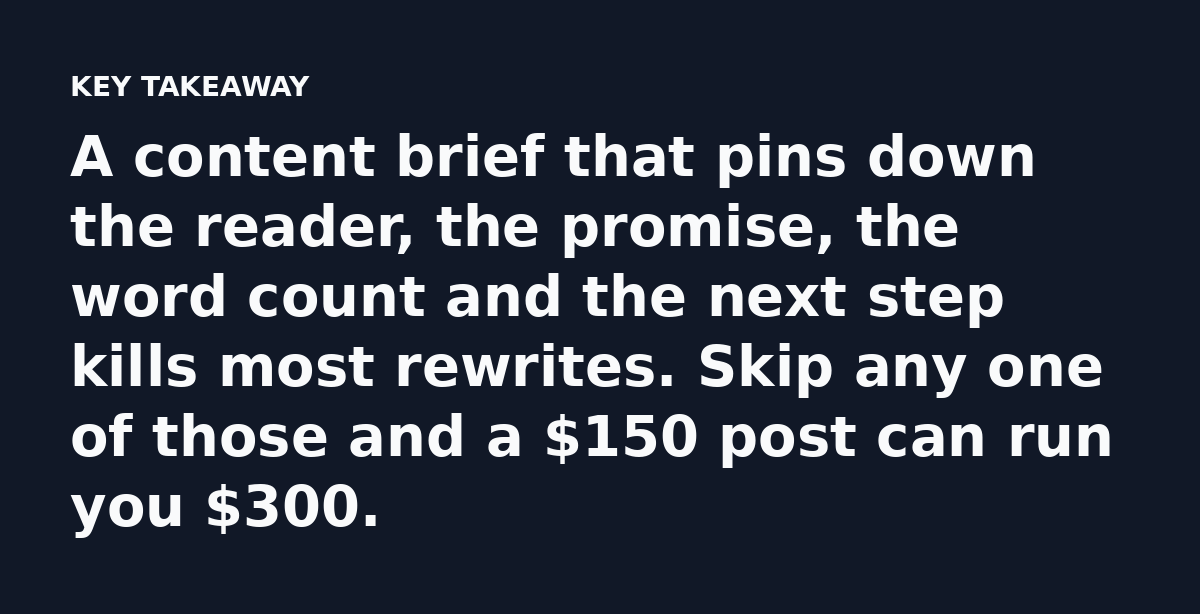
A 1,000-word post at $0.15 per word costs $150. One rewrite round costs the same again. Two rounds plus your own editing time and a single article has eaten $400. The brief takes 20 minutes to write.
Why do done-for-you writers miss the mark so often?
They were handed a keyword and a deadline.
A writer on a marketplace often juggles five clients at once. With no brief they reach for the safest, most generic version of the topic. You get 1,200 words about email marketing that could belong to any company alive.
Your job is to remove the defaults.
What are the non-negotiable parts of a content brief?
Six fields. Miss one and the odds of a rewrite climb.
- Reader: one person, with a role and a problem.
- Promise: the single thing they walk away knowing.
- Intent: what they typed into search and what they want back.
- Word count: a target plus or minus 10 percent.
- Tone: a real example the writer can copy.
- Next step: the one action you want after the last line.
The reader field
Name the role and the exact task. “Operations manager at a 30-person logistics firm who spends four hours a week renaming invoices” beats “business owners” every time.
The promise field
One sentence. “After reading this, the reader can build a brief in 20 minutes that survives the first draft.” If you cannot write that sentence, the article has no spine and the writer will wander.
The intent field
Search intent sets the shape. Someone typing “how to write a content brief” wants steps. Someone typing “content brief template” wants a file to download. Same topic, two different articles. Tell the writer which one you are paying for.
How do you describe tone without vague words?
Do not write “friendly but professional”. Every writer reads that phrase differently. Paste two paragraphs from a post you already like. Point at them and say “like this”.
Add the hard rules. Ban puns and always write in second person. Keep average sentence length under 25 words and never use the word “solutions”. A writer can follow a rule. A mood is guesswork.
Does word count really matter?
Yes. It caps your cost and it sets expectations. A writer told “around 1,000 words” may deliver 600 and call it finished.
Give a range. “900 to 1,100 words, not counting the FAQ.” Then say what you will cut. Most drafts bloat in the middle. Tell them where depth belongs and where it does not.
Where do CTAs go in the brief?
Name one action. If a post pushes a newsletter signup and a download, the reader does none of them.
Put the main CTA in the next-step field with the exact anchor text. Without it writers drop a generic “contact us”. “Book a 15-minute call” beats “get in touch” because it tells the reader what happens next.
What does a weak brief cost you in real money?
Track it once. Count the hours you spend editing writer drafts in a month. Multiply by what your own hour is worth. Most operators find the editing bill is larger than the writing bill.
A 20-minute brief can halve that editing time. Run the numbers on your last five articles and the leak becomes obvious.
Can you write a usable brief in 20 minutes?
Yes. Open a template with the six fields. Fill the reader field from a real customer conversation and pull the promise from your keyword. Set the word range and link one example for tone. Write the next step.
Then read it back. If a stranger could write the article from your brief alone, it is done. If they would still have questions, those questions are the answers you forgot to add.
What should you do before you send the next assignment?
Write the brief before the writer asks anything and before the first draft comes back wrong.
Attach it and ask the writer to reply with one remaining question. That reply tells you in 30 seconds whether the brief is clear or whether a rewrite is already on the way.
Your outsourced content improves the moment your brief does.
Read the full guide: Done for You Content Writing Service: 7 Mistakes That Waste Your Budget